Links on the Reservation
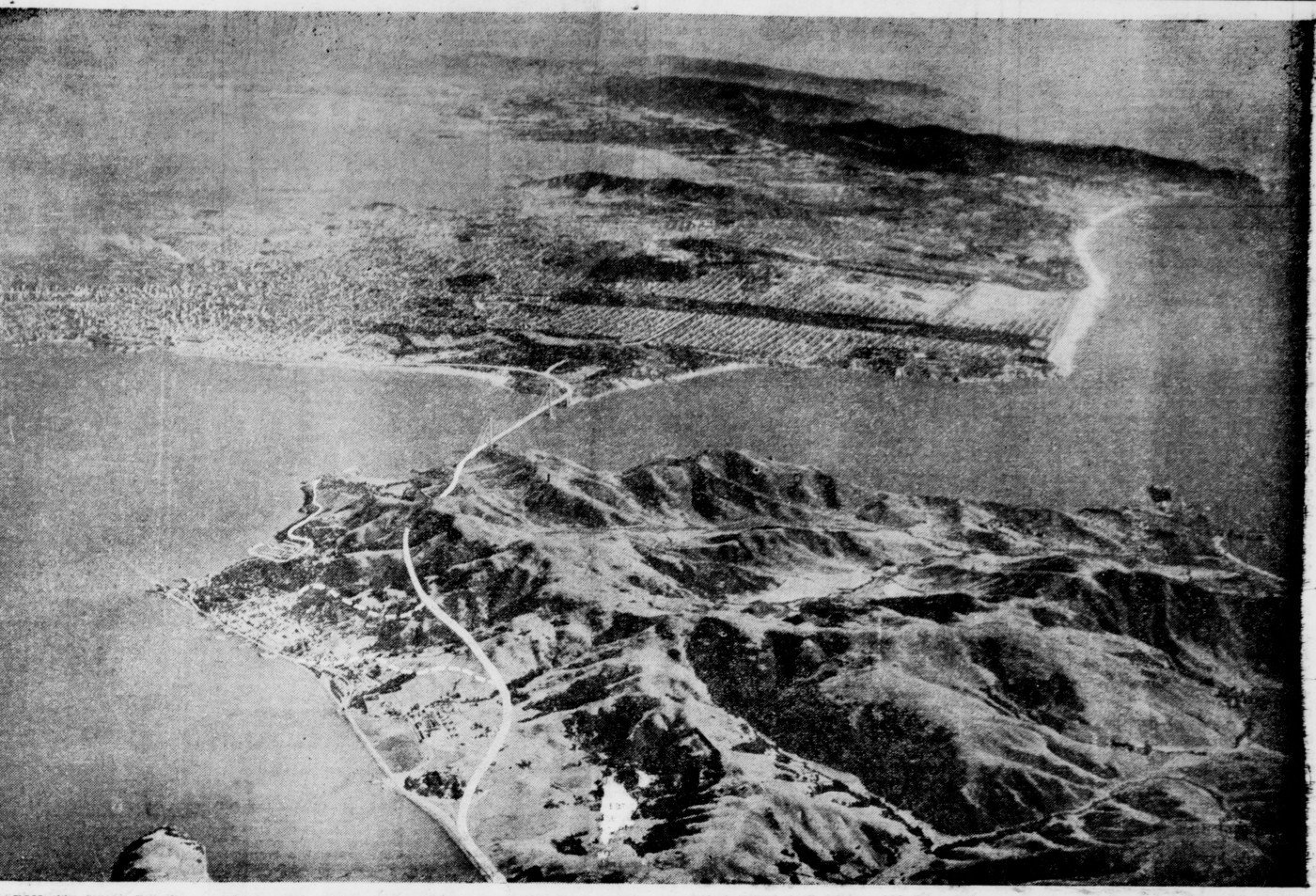
In the spring of 1900 Sausalito had been talking about a golf club for two years and had nothing to show for it. The town clung to its hillsides, and the owners of the few level tracts, the Sausalito News complained, would sooner pasture cows than lease to sportsmen1. Just over the ridge, the Fort Baker reservation "has often been looked upon with longing eyes by residents in this vicinity as an almost ideal place for golf"1.
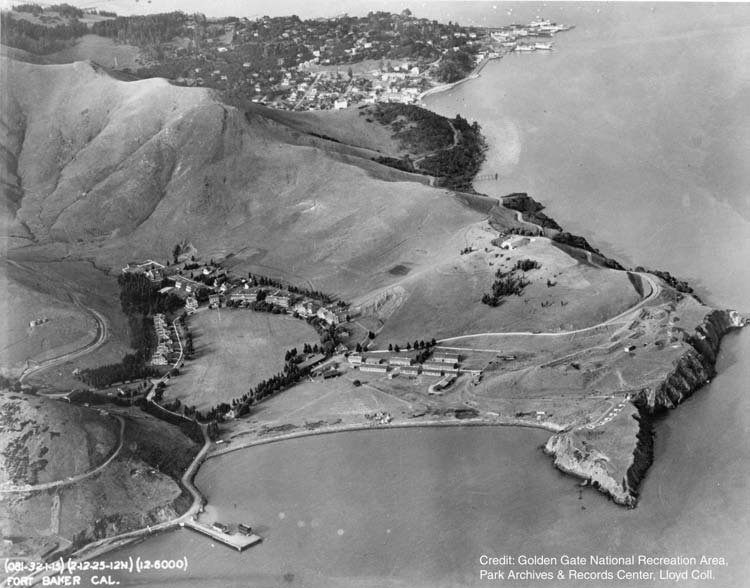
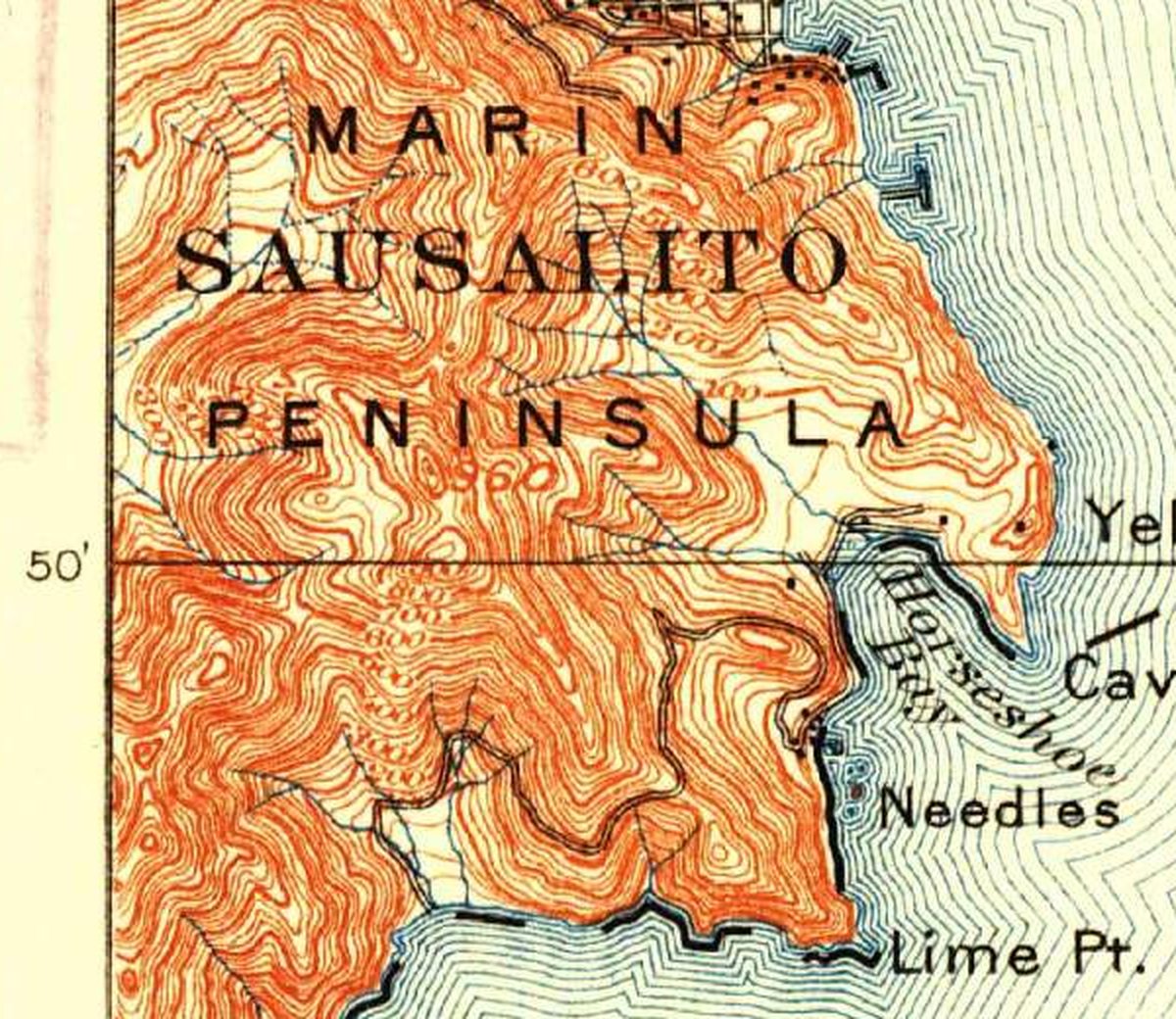
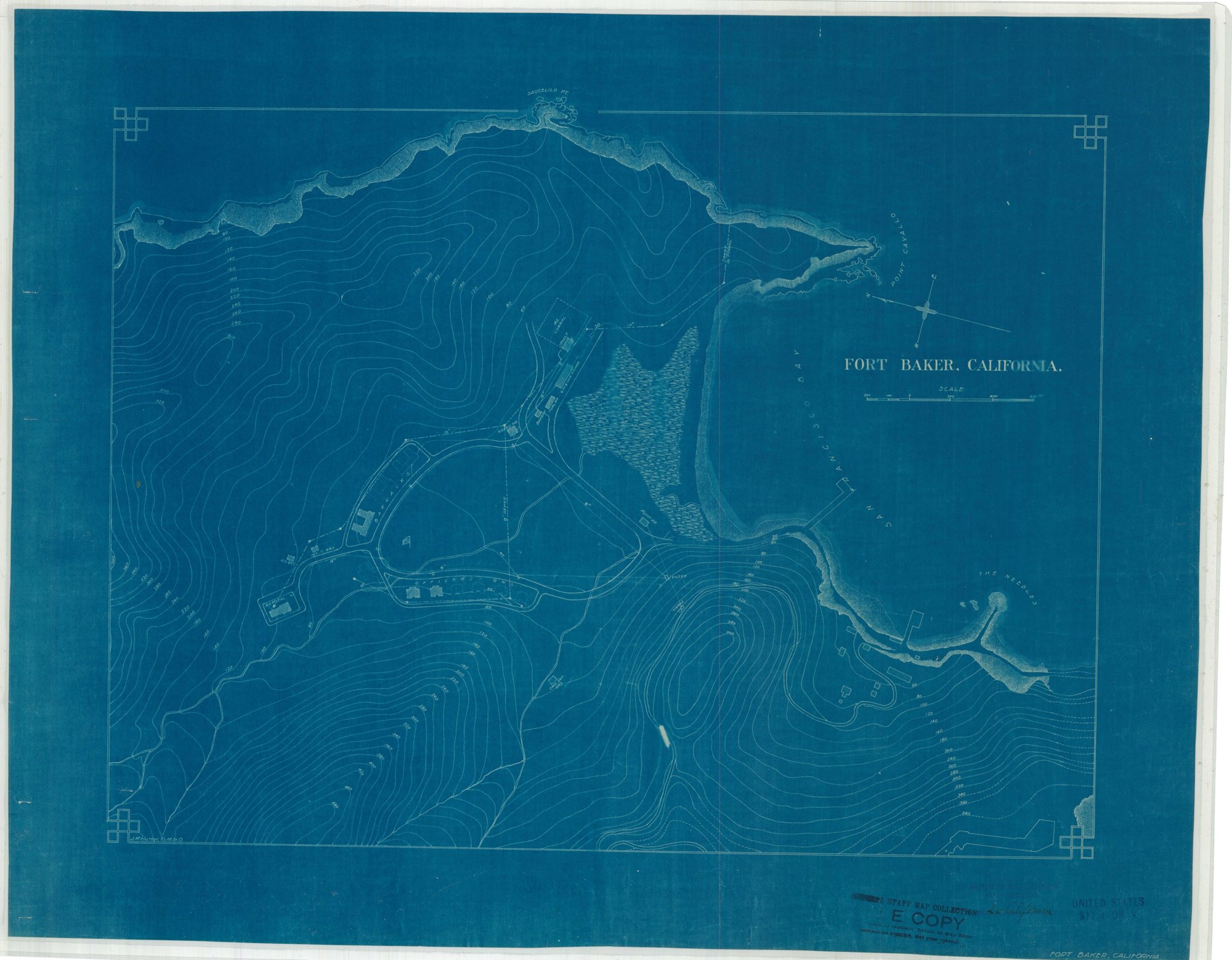
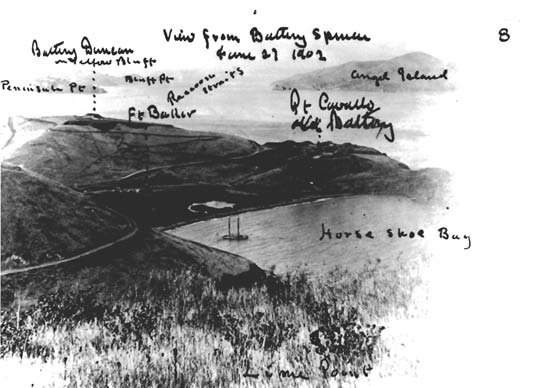
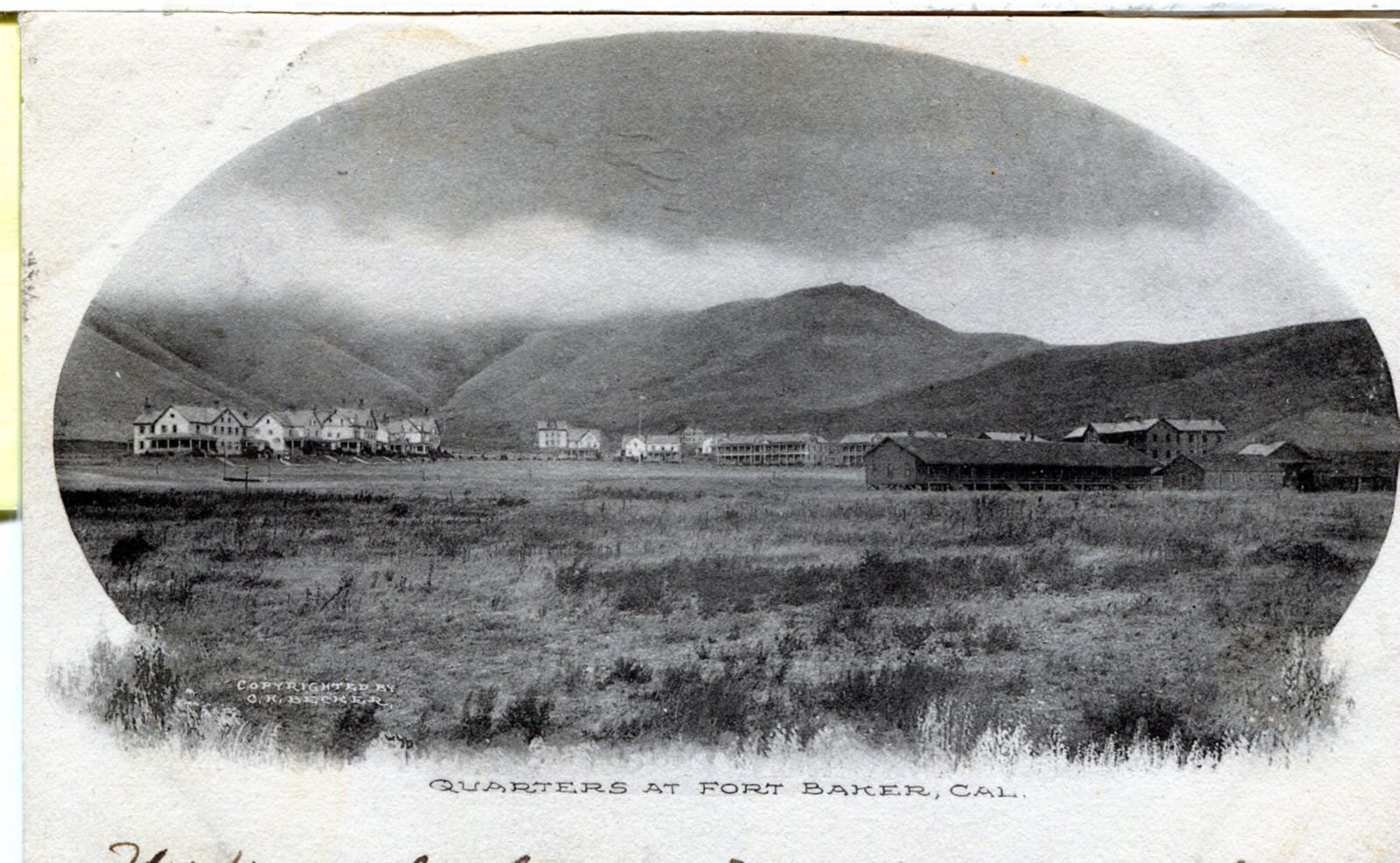
It was not an easy place to borrow. Fort Baker was a young artillery post on Horseshoe Cove, renamed from the old Lime Point reservation in 1897, its first garrison living in two wooden barracks barged over from the Presidio2. The 1900 census found only 41 soldiers there, but new batteries for big guns were going into the headlands around them2, and sentries kept the public away from them1.
Two Sausalito men set out to open the gate. , of the First National Bank, "first agitated the golf question in Sausalito"3,4. , an engineer, supplied the connection to the Army1. The papers never agreed on his rank, but the News always called him Colonel, and so does this history3,5,6.
wrote to the Army on behalf of "a number of ladies and gentlemen of Sausalito." The post commander endorsed his letter on 17 April 1900 and sent it up to General 's Department of California, and the reply of 2 May reached Draper through Lt. Henry C. Clark of the Third Artillery, the second lieutenant commanding Fort Baker1. The department commander had "no objection," provided the golfers understood that the permission "confers no rights of occupancy"1.
Sausalito heard more in it than that. The Call wrote that "has donated to the projectors of the club the use of the reservation"7, and the News called it "practically a long lease to the club, without compensation, during good behavior"1. A week later the Call had it right: no lease, no buildings, and tents for dressing rooms8. The golfers were guests on government ground, and the News credited the permission "largely" to Draper's influence with Shafter3.
Nine Holes Behind the Barracks
The course was planned by , until recently the instructor of the San Francisco Golf Club on the Presidio links4,9. He put it in the valley right behind the barracks, the first five holes climbing under the rugged hills and the four coming home looking out over the bay, where "all the Alameda shore, Alcatraz island, Angel island and the city will be spread before them"1,10. By 26 May had gone home to Scotland8, and Draper supervised the work on the ground1,4. A 1983 history of Sausalito says the members built all the traps and greens themselves11; both versions fit the papers of 1900.
The club was organized on the night of 25 May, with Keeler, A. T. Marvin and Draper as its committee of arrangements8. The membership list ran to scores of Sausalito families, and the News added that "Not to be a member of the club will write one down as 'not in it'"1.
The links opened formally on Decoration Day, 30 May 1900, though the holes were not yet ready; members lunched in tents and tried a few practice shots9,4,3. , of the Southern Pacific, became president, with Draper vice president, Keeler secretary and treasurer4. Lieutenant Clark, the post's own commander, sat on the council and the Greens Committee4,3. The men who ran Fort Baker and the people who played on it were, from the first, partly the same people. Harper's later counted 98 members, paying a $5 entrance fee and dues of $212.
"Since the opening day, on May 30th, the links have been the Newport of Sausalito," the News wrote, though most players were novices3. By late June the road to the links was crowded every Saturday13. A new road had been promised, built by 100 military prisoners from Alcatraz7,1; it came slowly, and East Road was finished only in 190114,2.
Clay Greens and Blind Gulches
Summer was hard on the course, and in August the Call reported that nothing could be done until the rains had soaked the ground15. That autumn the Army planned a permanent post around a parade ground at the head of Horseshoe Cove2. Only a barracks and some officers' quarters would go up at first, but the club still had to lay out its first two holes and the last one afresh16.
There was good news too. Shafter allowed a clubhouse on the reservation16, a permission the Call said had never before been granted on a Western military reservation, and let the club lay out the course on any part of the reservation it liked17.
The Call's column of 1 December 1900 is the best account of the links in their first year. The first four holes crossed rough ground; the fifth was cut by little ravines; then came a steep hill, a gorge, a ridge with two small blind gulches, a downhill drive over another gulch, a screen of trees with a narrow gap, and a green guarded by a marshy hazard17. The greens were not greens at all. No one had found the water to keep turf alive, so "They are of clay and sand, rolled smooth and hard"17. The fairway grass was tussocky and gave bad lies18.
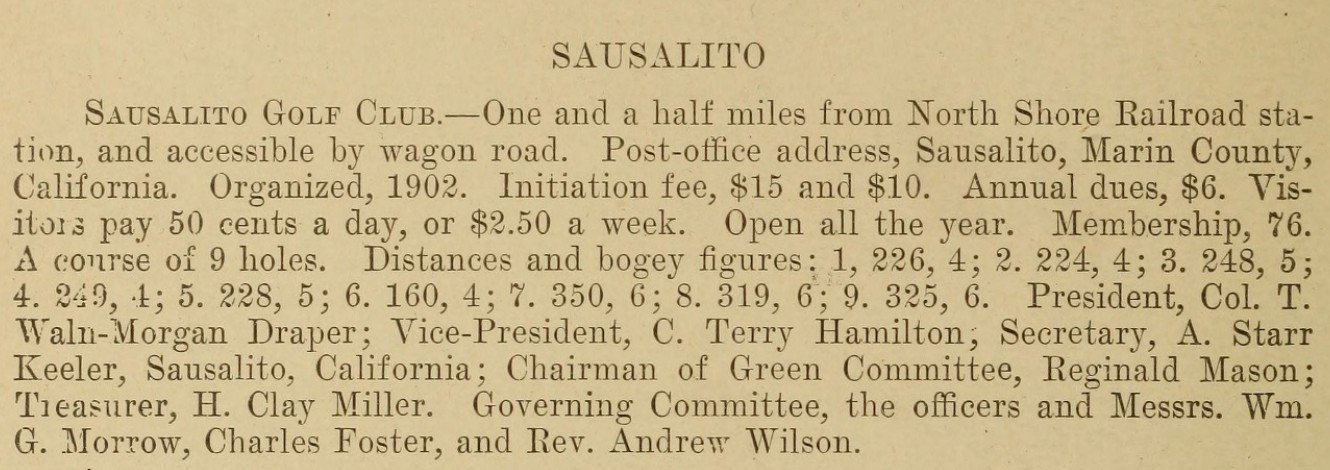
By 1901 one hole was called the "Boer trap," with "as fine a group of natural hazards as can be found anywhere"19, and the ground rules mentioned telegraph wires, ditches, flagged marsh and "the enclosure known as the hospital"20. The only full scorecard, in the Official Golf Guide of 1902, gives nine holes of 160 to 350 yards, 2,329 yards in all, with a bogey of 4421.
The First Tournament
The club's first tournament, for members only, offered ladies' singles, gentlemen's singles and mixed foursomes22, with "a handsome Dutch silver cup offered by Mr. " as a prize23. Set for 10 November, it "was not begun" that day, and qualifying was played on the 11th24,25. Eight men qualified, among them , W. P. Horn, and Draper5. The ten women went straight into match play, "the usual formality of qualifying having been dispensed with in consideration of the occasion being their initial venture"26,5. The Call sometimes called the rounds eighteen holes, but the Chronicle said beforehand that all matches would be "over nine holes, as the course is a hard one," and the scores, from 67 to 99, were for nine27,22,28,29.
The semifinals came on 1 and 2 December. "A keen northerly wind blew across the links and rendered the lack of a clubhouse severely apparent," the Call reported18. Findley beat Horn, whom the News thought the best player in the club18,30. Chenery won the final, by one stroke in the Call's version, though the papers disagree on the score and on which man took which cup28,30,31. By June 1901 Findley held the Foster cup, which had to be won three times to be kept32.
The women's championship stayed in one family. On 8 December beat her sister Mabel in the final, and the Call called her "the strongest lady golfer on the Fort Baker links"33. Horn and won the mixed foursomes on 18 December34,35, and the Marin Journal ranked the links with any in the state31.
Colonel Bogey Comes to Sausalito
The club still needed a standard. , the Oakland Golf Club's professionals, agreed to play the course; the Call noted that one was "an open champion of the United States"29. The best score yet was "57 for nine holes, by a visitor from Boston"29.
They came on Sunday, 9 December, and an admiring crowd followed them round33. The clay greens, varying greatly in speed, sent approaches running off the far side, and balls were lost in the matted grass. Harry went round twice in 46, Horace in 52 and 4833. The News printed different figures, probably misprints, but agreed that Harry had broken the club's record36.
After consulting the brothers, the club fixed bogey at 4433,36. Seven months after Shafter's careful letter, it had a course, a champion of each sex, a bogey and permission to build a clubhouse. In the same column that reported the end of the tournament, the News noted a brick power house begun at Lime Point and added that "the construction of the new post buildings will be begun early in spring"35. The golfers had been told in May that the permission conferred "no rights of occupancy"1, and the Army's building work in 1901 would show what that meant.
Notes to Chapter I (36 sources)
- “Enthusiasm Shown For Golf Club,” Sausalito News, May 19, 1900. view source ↗
- National Park Service, Cultural Landscape Report for Fort Baker, Golden Gate National Recreation Area (2005). view source ↗
- “Golf IN Sausalito A Success,” Sausalito News, June 16, 1900. view source ↗
- “Sausalito Golf Links Opened,” Sausalito News, June 2, 1900. view source ↗
- “Golfers Pursue The Gutty AT Fort Baker.,” San Francisco Call, Nov. 24, 1900. view source ↗
- “Golf Booms ON Local Courses.,” San Francisco Call, Nov. 3, 1900. view source ↗
- “Golf Links Fob, Sausalito.,” San Francisco Call, May 19, 1900. view source ↗
- “Golf Club Organized.,” San Francisco Call, May 26, 1900. view source ↗
- “Golf Still Holds Its Many Devotees,” San Francisco Call, June 2, 1900. view source ↗
- “News of the Golfers: Club Is Organized at Sausalito,” San Francisco Chronicle, May 19, 1900, p. 8 (ProQuest Historical Newspapers). view source ↗
- Jack Tracy, Sausalito, Moments in Time (Windgate Press, 1983), p. 65. view source ↗
- Harper's Official Golf Guide, 1901, p. 79. view source ↗
- “The Old Mud Pond Must GO,” Sausalito News, June 30, 1900. view source ↗
- “Lady Golfers Open Season AT Presidio,” San Francisco Call, Oct. 6, 1900. view source ↗
- “With Brasste and'Putter.,” San Francisco Call, Aug. 4, 1900. view source ↗
- “Golfers Will Soon BE Busy ON City Links,” San Francisco Call, Oct. 20, 1900. view source ↗
- “News OF The Golf Club Experts. Professionals From Oakland Will Try to Pull Down the Sausalito Record.,” San Francisco Call, Dec. 1, 1900. view source ↗
- “Close Contests ON Fort Baker Links,” San Francisco Call, Dec. 3, 1900. view source ↗
- “Golf Instructor For San Rafael,” San Francisco Call, May 18, 1901. view source ↗
- “Sausalito Golf Club Ground Rules.,” Sausalito News, June 15, 1901. view source ↗
- The Official Golf Guide, 1902, p. 118 (Internet Archive). view source ↗
- “Sansalito Golf Tournament.,” Sausalito News, Oct. 27, 1900. view source ↗
- “The Golf Tournament,” Sausalito News, Nov. 17, 1900. view source ↗
- “Golfers Strive For The Council's Ctjf,” San Francisco Call, Nov. 11, 1900. view source ↗
- “Great Golfers Will Show AT Santa Monica,” San Francisco Call, Nov. 17, 1900. view source ↗
- “Golf Club Tournament,” Sausalito News, Nov. 24, 1900. view source ↗
- “Golf on a New Links: Much Local Interest Taken in the Play of the Sausalito Club,” San Francisco Chronicle, Nov. 17, 1900 (ProQuest Historical Newspapers). view source ↗
- “Golfers IN Round-Robin Tournament,” San Francisco Call, Dec. 8, 1900. view source ↗
- “Class B Sweepstakes ON The Presidio Links,” San Francisco Call, Nov. 25, 1900. view source ↗
- “Golf ON The Local Links,” Sausalito News, Dec. 8, 1900. view source ↗
- “Sausalito Items.,” Marin Journal, Dec. 20, 1900. view source ↗
- “Match Games ON The 60LF Links,” San Francisco Call, June 8, 1901. view source ↗
- “Golf Experts Visit Fort Baker Course,” San Francisco Call, Dec. 10, 1900. view source ↗
- “Golf Cracks Bothered BY Clay Greens,” San Francisco Call, Dec. 15, 1900. view source ↗
- “Preparations For Holiday Festivities,” Sausalito News, Dec. 22, 1900. view source ↗
- “Exhibition Game AT Golf Links,” Sausalito News, Dec. 15, 1900. view source ↗
Barracks on the Fairways
A House on the Hill
By the winter of 1900–01 the Sausalito Golf Club had a season behind it, nine holes in the valley behind the barracks at Fort Baker, played by leave of the Department of California on the understanding that the permission conferred "no rights of occupancy."1 What the golfers wanted next was a roof. In October 1900 , as a courtesy, agreed to allow a temporary clubhouse on the links,2 "a permission never before granted on a Western military reservation," as the Call put it.3 The paper later credited , at whose request the order was issued.4
Permission was not money. In March 1901 the directors asked members to lend the club money or buy lockers at $10 each, and the replies were encouraging.4 In April the Albatross Club, the officers and wives of the Fish Commission steamer Albatross, staged tableaux vivants for the building fund.5 By May the house was nearly done: "Though of simple construction and containing only two rooms, it will be a great convenience to the golfers."6,7
At the second annual meeting, on 25 May 1901, the Sausalito News boasted that in one year the club had built "a splendid golf course and a fine commodious club house," and was "free from debt."8 Three days later the directors made president, with , and as the other officers and over the greens.8,9 Finishing the house took all summer; openings announced for June and the Fourth of July came and went,10,11,12 and on 29 June an exhibition of Parisian posters and a dance at the Yacht Club house raised money to complete it.13,14,15
Beginners Abroad
In February 1901 the club decided to field teams against other clubs.16 The results were humbling. Sausalito lost at San Rafael in March,17 and the return match in May had to be played at San Rafael too, because the Fort Baker course was so overgrown with thistles and weeds that it could not be played; a team of mostly beginners lost again.18,19 Even so, the Call found the course "certainly a sporty one," with the "Boer trap" offering "as fine a group of natural hazards as can be found anywhere."18 In June, at Oakland, captain could find only four players,20,21 and the Wave called the match "a walk over — for Oakland."22
At home the trouble was grass, the monthly dues being too small to pay men to keep down "the thistles and thick grass."23 The local rules sketch the ground: a ball hitting a telegraph wire could be replayed, and one driven into the marsh, or into "the enclosure known as the hospital," dropped without penalty.24
Fire and Barracks
On 21 June 1901 a grass fire burned through the afternoon over the reservation's hills, more than a thousand acres by the Call's account, and came within yards of headquarters before convalescent soldiers held it. "The soldiers say that it was set by a party of golfers from Sausalito who were endeavoring to burn off the links." It was the third fire laid at the golfers' door, and the Call expected the club would be asked to move.25 No later report says it was. Two weeks later the Chronicle remarked, without mentioning any fire, that "burning the grass" had helped the course greatly.26
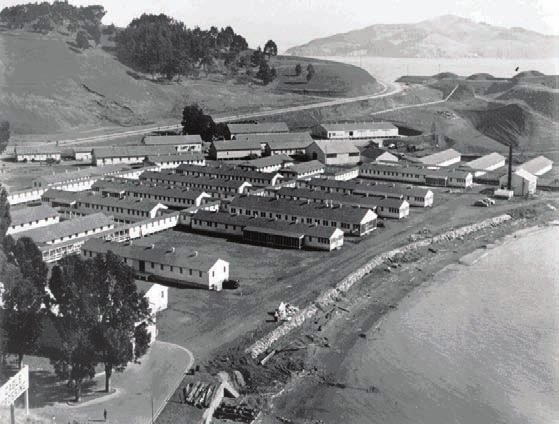
The real threat was the Army's building. Construction began in 1901, and by 1902 the valley held officers' and NCO quarters, a barracks for a company of artillery, a hospital, storehouses, a stable, a guardhouse and more.27 The golfers moved greens without much harm at first,4 but by July five holes were to be changed for the new buildings,26 and play was "pretty nearly at a standstill," the golfers having "lost several of the holes."28 By September four holes had been laid out afresh.29
On 19 October 1901 the club at last formally opened its clubhouse, "a simple structure, built on a hillside," with a dressing room for the ladies, a locker-room for the men and "a glassed-in piazza in front."30,31 There were driving and putting contests; Ruth Miller took both ladies' prizes and outdrove the men by a wide margin.31,32 A week later two holes were still unplayable, but the house gave shelter from "the winds and storms which sometimes sweep down the canyon."33
Six Holes and a Flock of Sheep
That November the 68th Company of Coast Artillery became the garrison,27 and the club's ladies, led by Mrs. Charles Mason, were planting trees and flowers on the grounds.34
When the Foster Cup was finally played on 21 December, only six holes were left because of the government's building.41 of San Rafael won with 57 for the nine.42 The Call summed up a hard year: the first three holes spoiled, rock making bad lies, but once the barracks were done "most of the younger officers will probably devote a good deal of time to golf."39
"Impossible to Get a Course"
They never got the chance. In March 1902 heavy rains wrecked the greens,43 and by April there had been no play for months, the Call judging it pointless to improve the course while the government kept building.44 The Official Golf Guide for 1902 still listed nine holes of 2,329 yards and 76 members,45 probably on facts gathered in 1901.46
On 25 October 1902 the Call doubted the club "will be able to maintain its existence." Its course at Lime Point had been out of use for about a year, the country around Sausalito was too rugged to offer another, and the "hill tribes" of Sausalito would try lawn tennis instead.47
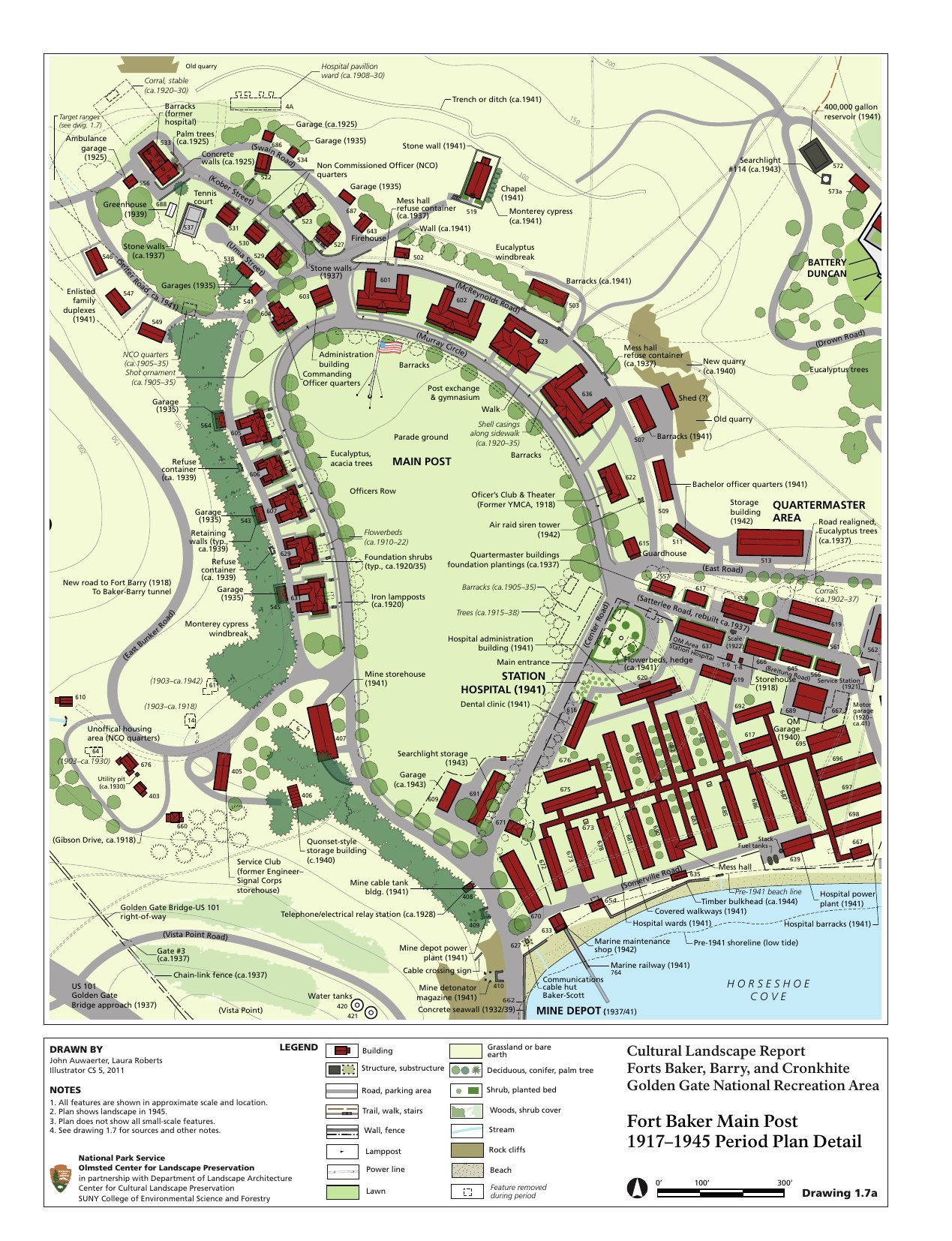
Meanwhile the Army remade the ground. From 1902 it laid out a parade ground with Murray Circle around it, sent the creeks into culverts, spread 25,000 cubic yards of fill, filled the marsh at the head of Horseshoe Cove with 80,000 more, and in 1903 sowed Australian rye grass.27 Some of the golfers' holes probably lie under that fill, since the course had filled the same valley, but no plan survives to prove it.
Tracy's 1983 history says the seeded parade ground "also served as part of the Sausalito Golf Course."40 No newspaper of the time describes golf on the finished lawn, so the caption is probably remembering the valley floor before the Army leveled it.
The Long Interval, 1903–1923
For the next twenty years the record of golf at Fort Baker is a blank, and the story has to be told through the post itself. A commanding officer's house, headquarters and more quarters went up around Murray Circle; water came in 1905 and electricity in 1908; by 1911 four companies of Coast Artillery were in garrison.27
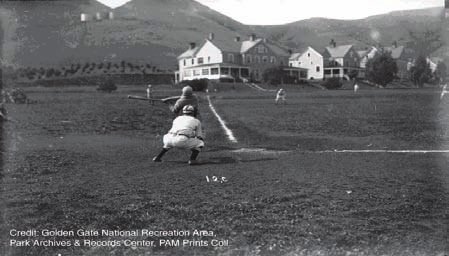
The parade ground became the post's playing field,27 and a Fort Baker baseball team turns up in the Marin papers in 1917.48 The officers were part of Sausalito life; when Capt. H. W. McCauley left in 1916, the News said he had won over the public with his hospitality.49
The Great War took guns, not ground: two of the post's batteries were disarmed and their guns sent to the front.27 By late 1923 of the Coast Artillery was at Fort Baker, lending the post's court to Sausalito's young basketball players "through the kindness of Captain ."50 Within four months he would give the town something larger: golf, back on the reservation.
Notes to Chapter II (50 sources)
- “Enthusiasm Shown For Golf Club,” Sausalito News, May 19, 1900. view source ↗
- The Argonaut, Oct. 29, 1900, p. 15 (Internet Archive). view source ↗
- “News OF The Golf Club Experts. Professionals From Oakland Will Try to Pull Down the Sausalito Record.,” San Francisco Call, Dec. 1, 1900. view source ↗
- “Golfers' Clubs TO Combine,” San Francisco Call, March 16, 1901. view source ↗
- “Home And Home Tournament ON Oakland Links,” San Francisco Call, April 13, 1901. view source ↗
- “Golfers Migrate TO San Rafael,” San Francisco Call, May 4, 1901. view source ↗
- The Argonaut, May 13, 1901, p. 14 (Internet Archive). view source ↗
- “Remarkable Success of the Sausalito Golf Club.,” Sausalito News, June 1, 1901. view source ↗
- “Golf Contest AT San Rafael,” San Francisco Call, June 1, 1901. view source ↗
- “Match Games ON The 60LF Links,” San Francisco Call, June 8, 1901. view source ↗
- “Golf Contests on Local Links.,” San Francisco Call, July 4, 1901. view source ↗
- “Among The Golfers,” San Francisco Call, July 6, 1901. view source ↗
- “Golf Contests For The Fourth,” San Francisco Call, June 29, 1901. view source ↗
- The Argonaut, July 8, 1901 (Internet Archive). view source ↗
- The Wave, July 6, 1901, p. 4 (Internet Archive). view source ↗
- “Sausalito Golf Club,” Sausalito News, Feb. 9, 1901. view source ↗
- “Tournament For Golf Players.,” San Francisco Call, March 9, 1901. view source ↗
- “Golf Instructor For San Rafael,” San Francisco Call, May 18, 1901. view source ↗
- “Return Match AT Golf,” Sausalito News, May 18, 1901. view source ↗
- “Oakland Golfers Beat Sausaxitans,” San Francisco Call, June 16, 1901. view source ↗
- “County Happenings.,” MCT, June 22, 1901. view source ↗
- The Wave, June 29, 1901, p. 4 (Internet Archive). view source ↗
- “Golf Match at Point Adams.,” San Francisco Call, June 15, 1901. view source ↗
- “Sausalito Golf Club Ground Rules.,” Sausalito News, June 15, 1901. view source ↗
- “Fierce Fire Sweeps Near Soldiers' Home,” San Francisco Call, June 22, 1901. view source ↗
- “Fort Baker Course Improvements,” San Francisco Chronicle, July 7, 1901, p. 11 (ProQuest Historical Newspapers). view source ↗
- National Park Service, Cultural Landscape Report for Fort Baker, Golden Gate National Recreation Area (2005). view source ↗
- “Golf Programme IS Full OF Dates,” San Francisco Call, July 21, 1901. view source ↗
- “Satjsalito Golfers TO Open Cltjbhotjse,” San Francisco Call, Sept. 22, 1901. view source ↗
- “Golfers ON Oakland • And Fort Baker' Links,” San Francisco Call, Oct. 19, 1901. view source ↗
- “Ochlfebs Compete ON Foet Bakeb Links;,” San Francisco Call, Oct. 20, 1901. view source ↗
- “Golf Prize Won BY Miss Miller,” Sausalito News, Oct. 26, 1901. view source ↗
- “Players OF Golf Again IN Action,” San Francisco Call, Oct. 26, 1901. view source ↗
- “Brief Items OF Interest IN Marin,” Sausalito News, Nov. 16, 1901. view source ↗
- “Many Tourneys for Local Golfers: Events on the Oakland, Sausalito and San Rafael Links,” San Francisco Chronicle, Oct. 19, 1901 (ProQuest Historical Newspapers). view source ↗
- “Golfers Active ON Many Links About The Bay,” San Francisco Call, Nov. 23, 1901. view source ↗
- “Goodall Cup The Object OF Golfers' Envy,” San Francisco Call, Dec. 7, 1901. view source ↗
- “Golf Tourney on Sausalito Links: Fort Baker Experts Will Play for Foster Cup To-Day,” San Francisco Chronicle, Dec. 21, 1901 (ProQuest Historical Newspapers). view source ↗
- “Golfers Ready For New-Year's Day Handicap,” San Francisco Call, Dec. 28, 1901. view source ↗
- Jack Tracy, Sausalito, Moments in Time (Windgate Press, 1983), p. 65. view source ↗
- “Golfers TO Try For Foster Cup AT Fort Baker,” San Francisco Call, Dec. 21, 1901. view source ↗
- “Golfers Compete ON Fort Batter Links,” San Francisco Call, Dec. 22, 1901. view source ↗
- “Golfers Fail TO Agree ON Match Game,” San Francisco Call, March 15, 1902. view source ↗
- “Presidio Links The Scene OF TO-Day's Game,” San Francisco Call, April 12, 1902. view source ↗
- The Official Golf Guide, 1902, p. 118 (Internet Archive). view source ↗
- Harper's Official Golf Guide, 1901, p. 79. view source ↗
- “Marin Golfers TO Meet Those OF Menlo Park,” San Francisco Call, Oct. 25, 1902. view source ↗
- “Sporting Brevities,” Marin Journal, May 17, 1917. view source ↗
- “Brief Items of Local Interest,” Sausalito News, Oct. 14, 1916. view source ↗
- “Brief Hems of Loca! Interest,” Sausalito News, Dec. 8, 1923. view source ↗
Captain Gibson's Nine
A Captain Who Played Every Day
For twenty years after the Sausalito Golf Club gave up its links, golf on the Fort Baker reservation was a memory. It came back because of one officer. By December 1923 of the Coast Artillery was at Fort Baker, lending the post's basketball court to Sausalito's young men,1 and by the spring of 1924 he was its commanding officer.2 "Since he was a confirmed addict of the royal and ancient pastime," the Sausalito News later said, "he had his ideas on the subject of golf architecture."3
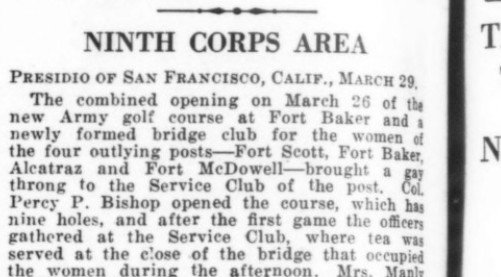
The Army and Navy Journal dated the opening to 26 March 1924: "Col. Percy P. Bishop opened the course, which has nine holes," with the captain's wife, Mrs. Gibson, as hostess.4 Five foursomes of officers from the bay's posts played the new nine while their wives opened a bridge club at the Service Club.2 The News gave the credit plainly: the course "was made possible largely through the efforts of ." He was president of the new Fort Baker Golf Club, with as secretary and treasurer.2
A banking magazine noted that Gibson had built it "for the benefit of the officers of the fort, of whom there are but few."5 But the opening notice ended with a line that would shape the club's whole life: "the commanding officer, Fort Baker, states that visiting members are welcome."2
Guests, Not Members
Welcoming civilians onto an Army post was not as simple as selling memberships. In April 1924 Gibson told the Sausalito Chamber of Commerce that all golf enthusiasts were invited to play, and by June residents who deposited $3.00 at the Chamber office could receive monthly, renewable invitation cards.6,7 The reason for the roundabout method was official: "the War Department prefers to have the Fort Baker Club deal with the Sausalito people as individuals, rather than as a club."8 Civilians could pay nothing but green fees.9
In October a civilian advisory committee set the green fee at $5 a month, with no initiation fee, dues or assessments, and raised the cap on visitors to 200; 127 were then playing.10 The club, the News explained in December, was financed by the dues of Army, Navy and Marine Corps officers and by the civilians' $5 a month, and it did the arithmetic: a civilian could play for five years before paying the $300 an ordinary club charged just to join.11 The banking magazine called the arrangement "substantially the same as the Presidio Golf Club" across the Gate.5
The guests made themselves at home. One columnist reported that Mrs. Lena Sorenson had been put off her game by a swearing male foursome nearby, and her remark that "the men who do not swear always get the best scores" drew a sour retort.12
Building the Links
The course was still being built around its guests. In July 1924 the club bought a large mower, and by January 1925 about $3,500 had been spent and the work was nearly finished.8,13 The Mill Valley Record later said the course "was built by the Officers Club, with the aid of 'Battery K,' 6th Coast Artillery."14 The skilled hand was a Scottish professional, , who had been with clubs in Detroit, Belvedere, Vancouver and California.13 His advice to News readers on curing a slice was blunt: "slicing is a desperate disease."15 By late February he had gone north to teach "after completing the building of the links at Fort Baker."16 The likeliest reading is that Gibson designed the holes and that and the soldiers built them.
A visitor at the Yates batteries early in 1925 looked down on "the golf course and the trees fringing the paths," with mules and horses grazing beside it.17 In the summer the club repaired the post's old spring-fed water system for about $200 and had plenty of water for the greens.18 Comforts followed: steel lockers, a tent on the beach, monthly dances with the Sixth Coast Artillery orchestra, and a Dodge sedan taxi summoned through the Fort Baker telephone operator.19,20,21 In 1926 Gibson would add a free Saturday boat from Pier 4 in San Francisco.22
Boys, Girls and a Model for the Army
In February 1925 the captain opened the course free to junior foursomes, 20 or younger, from Marin churches, schools and fraternal organizations, in a letter to the Chamber's secretary, his brother W. Gordon Gibson.23,24 The new professional, , would teach them on Saturday mornings without charge.25,23 On 14 February some forty youngsters were to be taught, in foursomes from Christ Church, Tamalpais High School, the Tamal Club and the Junior Yacht Club.26 A Glendale paper told its readers that the Fort Baker club "is training juvenile golfers free of charge."27
The Army noticed too. In April 1925 the Ninth Corps Area asked for the club's by-laws, plans and operating details "to be used as a model for other golf club projects on the Pacific Coast."28 The Sausalito papers never reported which posts copied it, if any did.
The First Tournament
The club's first real competition, after a rained-out attempt in April, was an 18-hole invitational medal play on Sunday 12 July 1925.29,30 With only nine holes, that meant going round twice. Eddy Redell did it in 73. "Redell's score established a new record for the Fort Baker course," Lt. announced.31 Nothing more is known of Redell; his name appears in these papers only this once.31
Eighteen Holes on Paper
Through the second half of 1925 the course grew larger in print than on the ground. In August Gibson invited local golfers to play "the 18-hole course" on weekdays.32 In September he said "workmen are now beginning the construction of nine more holes," and the Chamber's president knew of two families who had bought Sausalito homes because of the course.33 The Dipsea Highway Association offered anyone recommended by two people the chance to be "the guest of Uncle Sam on his 18-hole course" for $5 a month.34,35 Gibson himself was more careful, speaking in November of "the nine-hole golf links which will soon be enlarged to 18-hole links."36 The Mill Valley Record summed up the terms: "Regulations of the United States Army do not permit of dues."37
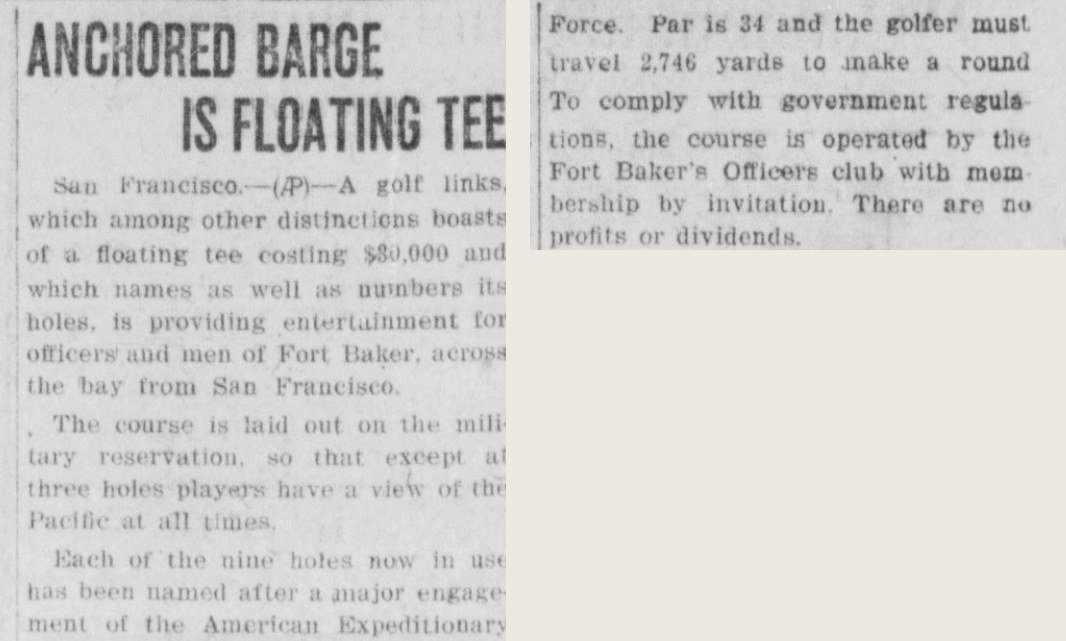
On 9 January 1926 the Sausalito News published the fullest description of the course that survives. The nine lay in the hills, with views of the straits and the Golden Gate from all but three holes. The first, second and fifth were on the parade ground, and the second and fifth had punchbowl greens the paper compared to the famous seventeenth at Pebble Beach. Membership was limited to 200, and "owing to government regulations, the course is operated by the Fort Baker Officers' Club."3
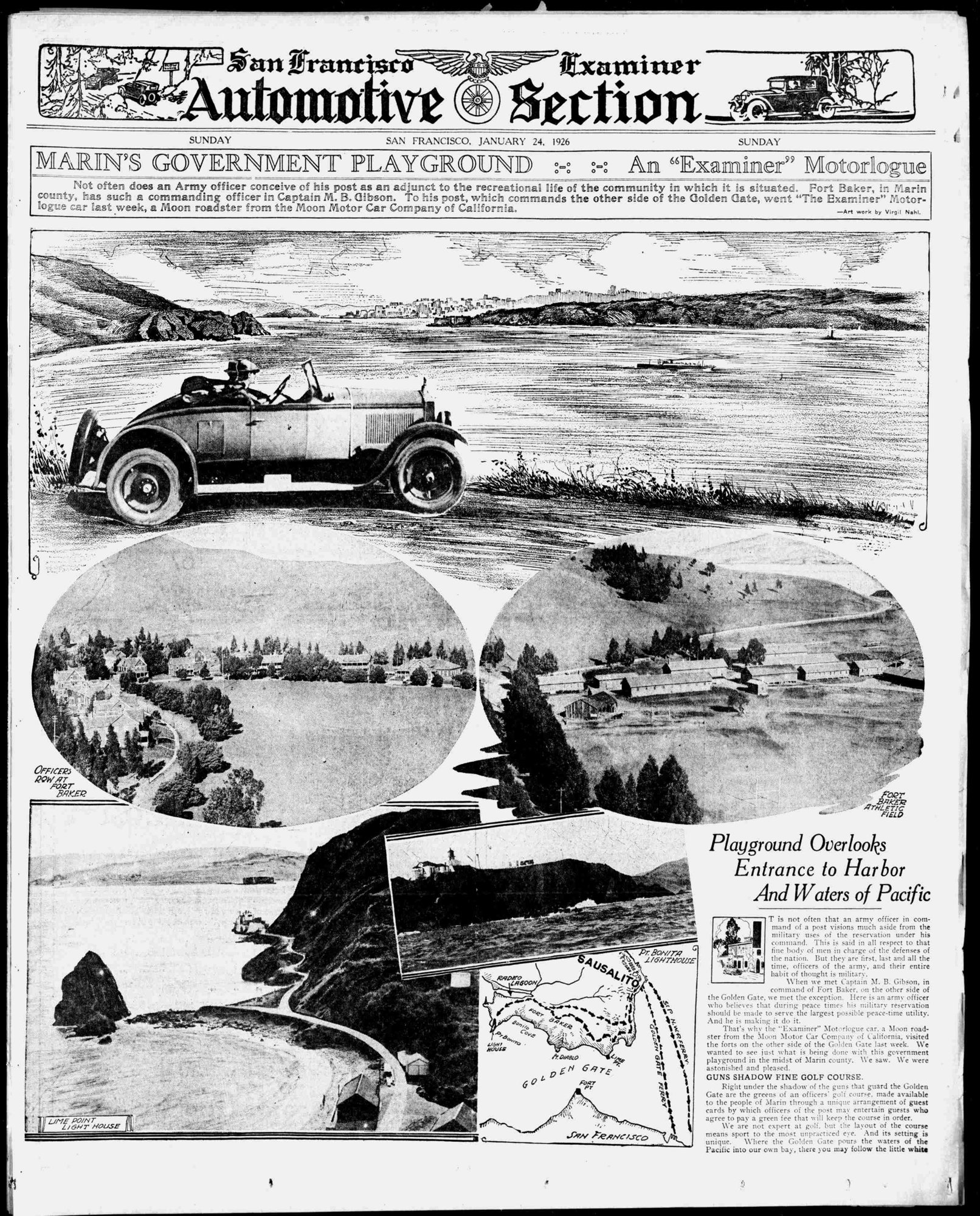
A formal opening promised for February went unreported in the News.3,41 The publicity kept coming all the same. Capt. wrote that a club near Menton cost over $1,000 to join, while at Fort Baker "no membership fee is required."42 On 24 January the San Francisco Examiner's Sunday motoring section made Fort Baker "Marin's Government Playground," praising an officer who believed his reservation should "serve the largest possible peace-time utility." Since Marin had no municipal course, it said, "Uncle Sam's reservation furnishes the opportunity for the poorer folks to enjoy this game."43,44 The Sausalito News reprinted it a week later.45
By the middle of 1926 Captain Gibson had made something new: an Army course run by an officers' club, with a few officers as members and many civilian guests paying five dollars a month, its holes named for the battles of 1918 and a barge in the cove for a second nine that existed only on paper. The parade ground where three of its holes lay is still an open lawn today.46
Notes to Chapter III (46 sources)
- “Brief Hems of Loca! Interest,” Sausalito News, Dec. 8, 1923. view source ↗
- “New Golf Course At Fort Baker,” Sausalito News, April 5, 1924. view source ↗
- “Fort H Golf Club Has AH Unique Coe,” Sausalito News, Jan. 9, 1926. view source ↗
- Army and Navy Journal, April 19, 1924, p. 832 (Internet Archive). view source ↗
- Western Banker / Coast Banker, 1925. view source ↗
- “Chamber of Commerce Directors Elect Officers,” Sausalito News, April 26, 1924. view source ↗
- “Golf Club Seeks Members,” Sausalito News, June 28, 1924. view source ↗
- “Golf Club Ready to Register Members,” Sausalito News, July 5, 1924. view source ↗
- “The Chamber of Commerce Hears a Noted Speaker,” Sausalito News, Oct. 4, 1924. view source ↗
- “Ft. Baker Golf Club Adopts New Rules,” Sausalito News, Oct. 18, 1924. view source ↗
- “Golf Club Great Asset to Community,” Sausalito News, Dec. 13, 1924. view source ↗
- “' The Outlander”,” Sausalito News, Nov. 1, 1924. view source ↗
- “Golf Club Notes,” Sausalito News, Jan. 10, 1925. view source ↗
- “Fort Baker Golf Club Increase of Membership Affords Rare Opportunity,” Mill Valley Record, Sept. 11, 1926. view source ↗
- “Fort Baker GcSf Professional Gives Advice,” Sausalito News, Jan. 10, 1925. view source ↗
- “The,” Healdsburg Tribune, Feb. 26, 1925. view source ↗
- “Beauty of the North Shore Section,” Sausalito News, Jan. 31, 1925. view source ↗
- “New Water Supply For The Golf Club,” Sausalito News, July 4, 1925. view source ↗
- “k)caMJews,” Sausalito News, June 20, 1925. view source ↗
- “Loca^g|Jews,” Sausalito News, June 27, 1925. view source ↗
- “Golf Club Taxi,” Sausalito News, Aug. 1, 1925. view source ↗
- “Fort Baker Gets S. F. Boat Service,” Sausalito News, Oct. 16, 1926. view source ↗
- “Marin County Boys May Use Fort Baker Course Free,” Sausalito News, Feb. 7, 1925. view source ↗
- “W. Gordon Gibson Appointed C of C. Secretary,” Sausalito News, Feb. 7, 1925. view source ↗
- “Page 8 Advertisements Column 2,” Sausalito News, Feb. 7, 1925. view source ↗
- “Sausalito Will Be Noted for Golfers,” Sausalito News, Feb. 14, 1925. view source ↗
- Glendale Evening News, March 30, 1925, p. 10 (Internet Archive). view source ↗
- “Motorists Using 1324 License Plates to Be Arrested,” Sausalito News, April 4, 1925. view source ↗
- “Fort Baker Ladies Hold Open House,” Sausalito News, April 4, 1925. view source ↗
- “Golf Tournament Tomorrow AT Fort Baker Links,” Sausalito News, July 11, 1925. view source ↗
- “Sets Course Record IN Winning Tournament,” Sausalito News, July 18, 1925. view source ↗
- “Golfers Invited TO Play Over FT. Baker Links,” Sausalito News, Aug. 1, 1925. view source ↗
- “New Building Code Planned Fop Sausalito Chamber of Commerce* Is Working With State Housing Officials,” Sausalito News, Sept. 19, 1925. view source ↗
- “Fort Baker Links Regarded AS Most Unique Course,” Sausalito News, Oct. 31, 1925. view source ↗
- “Uncle Sam’s Golf Course Any Citizen Interested Is Invited to Join,” Mill Valley Record, Oct. 31, 1925. view source ↗
- “Marin County Boosters Meet Fifteen Citizens of Mill Valley Attend County Organization,” Mill Valley Record, Nov. 7, 1925. view source ↗
- “Marin Promotion Dinner Dance; Men And Women TO Work Jointly,” Mill Valley Record, Jan. 9, 1926. view source ↗
- “$30,000 Floating Tee Is Part of Army Links at Fort Baker,” New York Times, Feb. 17, 1926, p. 17 (AP) (ProQuest Historical Newspapers). view source ↗
- Associated Press, “Anchored Barge Is Floating Tee,” Washington C.H. Herald, March 10, 1926, p. 8 (also Los Angeles Times, Feb. 17, 1926). view source ↗
- “Anchored Barge IS Floating Tee For U. S. Army Golfers,” SPDN, March 20, 1926. view source ↗
- “Golf Dinner Dance,” Sausalito News, April 24, 1926. view source ↗
- “11, Hi Prefers (Wi io more,” Sausalito News, Jan. 2, 1926. view source ↗
- “Marin’s Government Playground: An ‘Examiner’ Motorlogue,” San Francisco Examiner, Jan. 24, 1926, Automotive Section, p. 1 (p. 53) (ProQuest Historical Newspapers). view source ↗
- “Motorlogue Car Visits Forts of Marin County: People Enjoy Reservation at Ft. Baker,” San Francisco Examiner, Jan. 24, 1926, Automotive Section, p. 2A (p. 54) (ProQuest Historical Newspapers). view source ↗
- “Aptain Gibson Helps Citizens MU ET. Baker an Francisco Examiner Says Local Commandant Is Exceptional Officer.,” Sausalito News, Jan. 30, 1926. view source ↗
- National Park Service, Cultural Landscape Report for Fort Baker, Golden Gate National Recreation Area (2005). view source ↗
Uncle Sam's Course
By the late summer of 1926 's nine had settled into the life of a small club. In September the harbor-defense commander let it invite fifty more civilians, on terms the Mill Valley Record printed: no initiation fee, no dues, only the $5 monthly green fee.1 That was how the Army kept its rule that civilians could play as officers' guests but could not be members of a post organization.1,2 A club folder called the course "A veritable mosquitoless paradise—protected from the wind and fog."1
The new professional, , kept it "constantly being improved."1 He also launched a weekly event: "Weekly medal play handicap sweepstakes are now being staged at the Fort Baker Golf club each Sunday," with golf balls for prizes.3 In October 1926 Forts Baker and Barry began a trial Saturday boat from Pier 4 in San Francisco, and golf club members rode free on showing their cards; the Sausalito News credited Gibson with arranging it.4,5
The Tax Man and the Congressman
The club's odd status soon drew the Treasury, which demanded a monthly "membership tax" on the civilian players, with back taxes of more than $1,200, though Army regulations said membership "must be restricted to members of the army and their families."2 C. E. Persons of Sausalito took up the case and pressed it. On 19 March 1927 the Treasury ruled that the green fees were not taxable, and the club's secretary, a lieutenant whose name the two papers spelled differently, said it would seek a refund at once.2,6
The captain had other things on his mind. A daughter was born to the Gibsons at the post in January 1927.7 The United Press reported his "Gibson code," a numbered vocabulary of more than 10,000 words meant to bridge languages, tested on nine soldiers who each spoke a different tongue.8 In February he was "taken seriously ill" and rushed to the Presidio hospital.9 In June the Army ordered him to the Coast Artillery School at Fort Monroe, Virginia, sailing on 3 July.10 The founder's first tour was over.
Bill Hackney's Spring
In December 1927 the club hired as professional, "one of eight brothers, all of whom are professionals," and he and two assistants laid out new greens for the second and ninth holes.11 His big idea was the old one: nine more holes, four on "the bluffs southeast of the present course and bordering the bay" and five near the rifle range, to give members "one of the sportiest courses in Marin county." The clubhouse had been redecorated over the winter with a lounge, a women's card room, a dining room and locker rooms.11 The Mill Valley Record repeated the promise that May and found the course "in splendid condition."12 In April a "Ladies' Day" of morning golf, luncheon and bridge drew 45 members and guests.13,14
A Post Without a Garrison
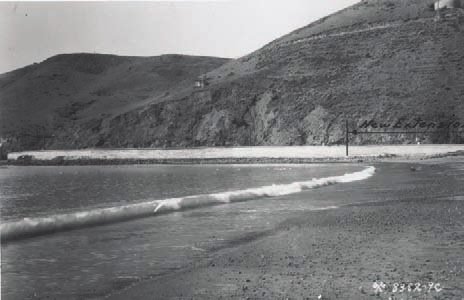
The Army, meanwhile, was emptying the post. The Coast Artillery garrison was deactivated in 1928, and until 1937 a caretaker detachment kept the fort.15 The work went on: in 1929 the Quartermaster Department built a concrete seawall along the western edge of Horseshoe Cove and resurfaced East Road and the other post roads.15
The golf went on too, more quietly. The Golfer's Year-book for 1930 listed the "Fort Baker Officers Club, Estd. 1923, 9 holes, 2569 yards, par 33," with James Thrapp as professional, shorter than the 1926 card, which suggests the holes had been changed.16 On 3 February 1930 a golfer's swing struck Miss Glenna Brown, standing behind him, in the face, breaking her jaw and nose.17 That December, when Sausalito golfers beat Mill Valley in a team match, the News remarked that "Sausalito has no golf club organization," and did not mention Fort Baker.18
Silence, and a Restoration
Then the record goes silent. From the end of 1930 to early 1935 nothing has been found about golf at Fort Baker in the Sausalito News or the Mill Valley Record. The Depression and an empty post are the likely reasons, but no source says so. Gibson was far away, with the 9th Coast Artillery at Fort Banks, Massachusetts.19
In February 1935 the News reported that the Fort Baker Officers Club meant to have the course "reconditioned and reorganized."20 That spring the Coast Artillery Journal said relief workers of the State Emergency Relief Administration would put the links back as they had been under General Percy P. Bishop, who as a colonel had opened the course in 1924.21,22
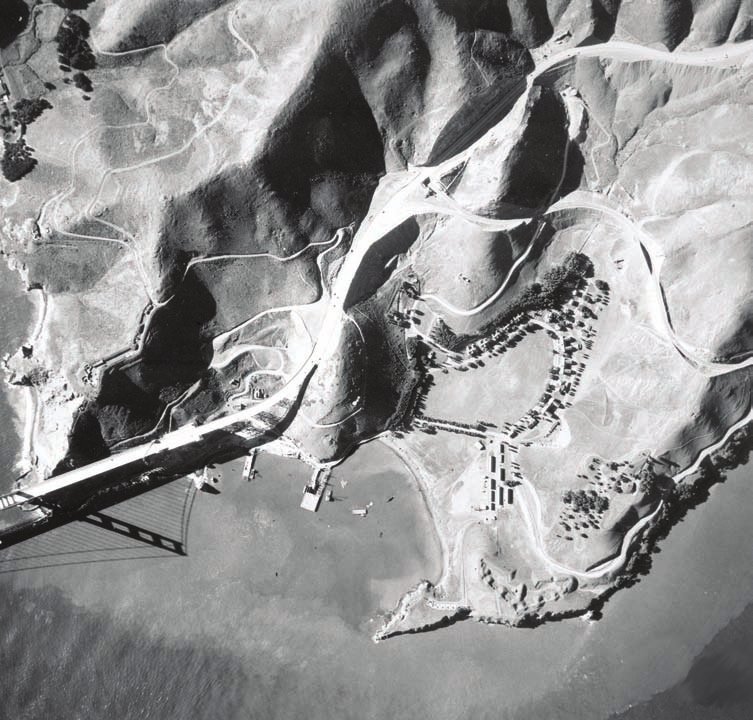
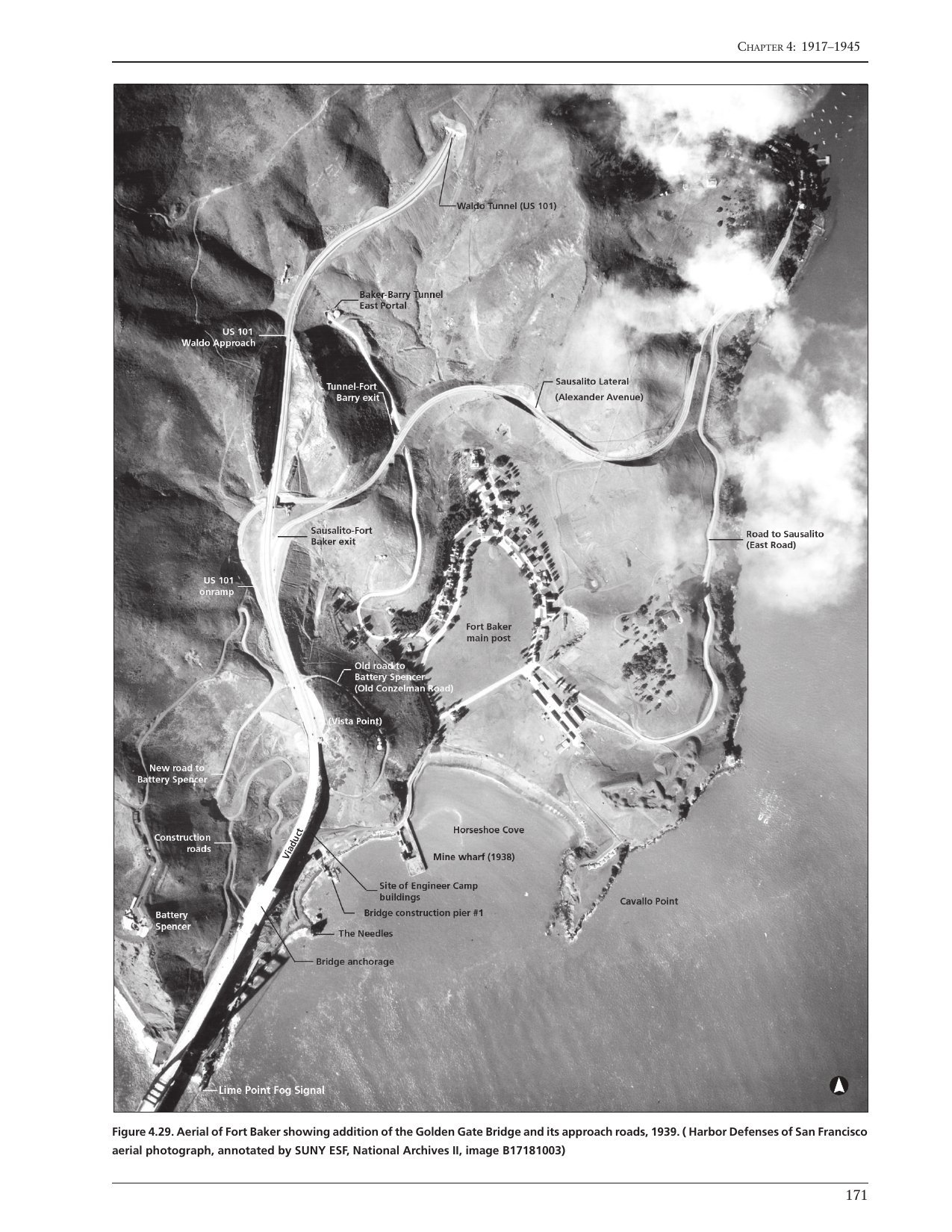
The bridge was the other great change. The Army had granted the Golden Gate Bridge an easement through the reservation in 1931.15 In July 1935 the News explained that the main approach tunnel would come out above the post buildings and the golf links, the last mention of the links in these years.23 Of 1936 nothing has been found. Gibson, now a major, was on Corregidor, a member of its Hole-in-One Club.24 When the Sausalito News next wrote about golf at Fort Baker, in October 1937, he would be back to start again.25
Notes to Chapter IV (25 sources)
- “Fort Baker Golf Club Increase of Membership Affords Rare Opportunity,” Mill Valley Record, Sept. 11, 1926. view source ↗
- “NO Revenue Tax Fort Baker Golfers to Pay Only Green Fees.,” Mill Valley Record, April 16, 1927. view source ↗
- “Golf Club Going Weekly Tournament,” Sausalito News, Sept. 18, 1926. view source ↗
- “Fort Baker Gets S. F. Boat Service,” Sausalito News, Oct. 16, 1926. view source ↗
- “For Navy Day,” Mill Valley Record, Oct. 23, 1926. view source ↗
- “"Membership lAX" Golf Club Ruling HD MUCHI9,” Sausalito News, April 16, 1927. view source ↗
- “Chapter VI,” Mill Valley Record, Jan. 22, 1927. view source ↗
- “New Wire Code Undergoes Test,” MT, Jan. 22, 1927. view source ↗
- “Local News,” Sausalito News, Feb. 12, 1927. view source ↗
- Army and Navy Journal, 1927 (orders of June 11, 1927). view source ↗
- “Nine More Holes AT Lore Baker Course,” Sausalito News, May 5, 1928. view source ↗
- “Around The Bay,” Mill Valley Record, May 11, 1928. view source ↗
- “Social Notes,” Sausalito News, April 14, 1928. view source ↗
- “Social Notes,” Sausalito News, April 21, 1928. view source ↗
- National Park Service, Cultural Landscape Report for Fort Baker, Golden Gate National Recreation Area (2005). view source ↗
- Golfer's Year Book, 1930, p. 304. view source ↗
- “Unusual Accident,” Mill Valley Record, Feb. 14, 1930. view source ↗
- “Sausalito Golfers Clean Up on Mill Valley, Win Trophy,” Sausalito News, Dec. 5, 1930. view source ↗
- U.S. Army Order of Battle 1919–1941, vol. 2 (Combat Studies Institute, 2010). view source ↗
- “Cl SH Walker,” Sausalito News, Feb. 22, 1935. view source ↗
- Coast Artillery Journal, May–June 1935, pp. 225–226. view source ↗
- Army and Navy Journal, April 19, 1924, p. 832 (Internet Archive). view source ↗
- “Aerial Picture Gives Proposed tt Hiway Approaches to Golden Gate Span With Local Laterals,” Sausalito News, July 26, 1935. view source ↗
- Coast Artillery Journal, Sept.–Oct. 1936, p. 377. view source ↗
- “Golfers Invited TO Visit Course AT Fort Baker,” Sausalito News, Oct. 29, 1937. view source ↗
The WPA Course and the War
The Major Comes Back
In April 1937, a month before the Golden Gate Bridge opened, the Army and Navy Journal printed an order sending to the 6th Coast Artillery at Fort Winfield Scott in the Presidio.1 As a captain in 1924, Gibson had built the Fort Baker golf course with his own soldiers, and by the autumn of 1937 he was back in command of both Forts Baker and Barry.2 The newspapers had said little about the course since 1930.3,4
He did not wait long. At the end of October the Sausalito News reported that the Fort Baker Golf Club would be reorganized and the course was already being rebuilt under , the professional at the Presidio Golf Club.2 Gibson declared Sunday, 31 October, a visitors' day for Marin residents, with badminton, a tour of the golf course, lunch in the Tap Room and a drive out to the 12-inch guns of Battery Wallace.2 A week later the paper's editorial column said Sausalito golfers were glad to find the links open again, much nearer than anything else in the county.5
Men and Machinery
The money came from the New Deal. Works Progress Administration crews had been at Fort Baker since 1935, and among their 1938 landscaping jobs the Park Service's history lists grading "tees and greens for a golf course."6 That September Gibson announced an $856,598 WPA project to rehabilitate both forts, employing 908 men for a year.7
By March 1938 men and machinery were at work on the course and several practice holes were in play, under , described as an expert in golf construction.8 (The paper called him William; later items name him .)9,10 In April Gibson introduced Warman as the club's new professional, lately of Yosemite, offering free lessons to Army children and setting the green fee at $2 a month.9,11 A driving range was going in at the post entrance, in full view of the bridge.11
The sixty days stretched out. In September the News promised a November opening, and the Town Cryer column told Sausalito that membership was limited.12,13 November came without an opening, but the terms were settled: Sausalito residents could play as guests of the club for $2 a month, with no initiation fees or dues, and 71 of the 100 guest cards were already issued.14 Army rules let civilians be only guests paying green fees, a rule Gibson had worked within in the 1920s too.15 An editorial called the offer a rare opportunity.16
Six Holes, Then Nine
In March 1939 Gibson announced that the nine would open in the last week of June, and the News counted it among the finest in the North Bay.17 In April, with six holes finished, the officers invited Sausalito to play free on weekends with a guest card from the Chamber of Commerce.18
The course also found a school team. The Tamalpais High golf club held a tournament there on 14 April, and Fort Baker became one of the team's three courses for inter-club matches.19,20 Gibson then let the team and its faculty use the course free on school days, as the last greens were being graded.21 In 1925 he had opened the course free to Marin's junior foursomes.22
In mid-June the club set the opening for Sunday, 9 July. The course, built as part of a Federal project mostly through Gibson's two years of effort, ran 6,137 yards, with 18 tees on 9 holes, and par 71.23 That made the nine markedly longer than the nine of 1926, put at about 2,740 yards.23,24 The green fee was a quarter for nine holes.23
Open House, 9 July 1939
Gibson made the opening a holiday for both forts, with a beach picnic at Rodeo Lagoon, a bass derby, and golf starting with a professional exhibition match at 1:30, then a putting contest and a 50-yard pitch-and-putt.25 The 6th Coast Artillery Band played in front of the clubhouse, and cars parked on the parade ground.26 The guests of honor included Brig. Gen. H. T. Burgin and the club's new president, , who was taking over the post as Gibson left.27,28 The News called the day the culmination of more than two years of Gibson's work.26
No report of the day itself has turned up: no exhibition scores, no winning bass, no crowd count. The Park Service chronology records only an open house with a fishing derby, an exhibition golf match and a beach picnic.6 The News editorial of 13 July said the course had improved long-undeveloped ground and would bring the town and the post closer together.29
The same editorial said goodbye to Gibson. The Gibsons sailed from San Francisco on 18 July on the Army transport Republic, bound for Independence, Missouri, where he was to head military science and tactics at the high school.30 The Army and Navy Journal listed the order a little differently, but it was probably one posting.31 Crowell's promise to the town was short: "We will carry on!"29
The Hospital on the Marsh
After the dedication, the newspapers go quiet; no tournament or club election at the new course appears after July 1939. In May 1941 the War Department approved a large station hospital at Fort Baker to serve the fast-growing coast-defense garrison.6 It went on the flat the Army had made in 1903 by filling the marsh at the head of Horseshoe Cove, below the parade ground, and in about three months builders put up some two dozen wartime buildings linked by covered corridors. By the end of the war there were forty-five.6
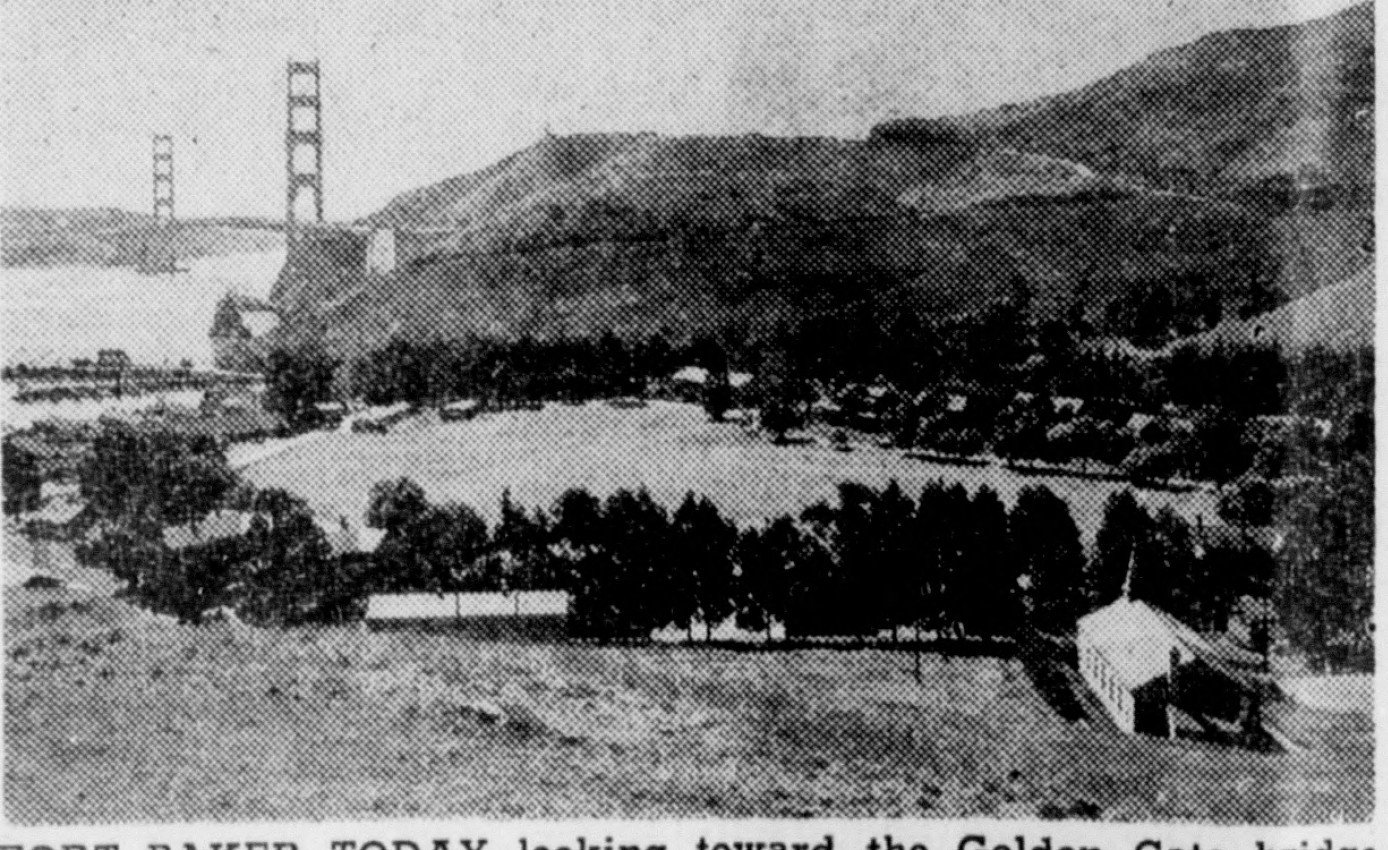
No newspaper found so far reports the closing of the golf course; it simply drops out of the record. Jack Tracy's pictorial history of Sausalito gives it one line: "Sausalito's golf course at Fort Baker was closed."32 The clearest statement came in May 1947, when the Sausalito News ran a photograph of the post and said many Sausalitans remembered the days when Fort Baker had an excellent golf course, given up during the war when the hospital was built.33
The Army took the hospital off active duty in 1948, but the golf course did not come back.6 In 1949 the Mill Valley Record noted that the Fort Baker course had been abandoned.34 A 1957 wire item blamed the Depression and later building for its loss, but the course had been rebuilt with Depression relief money; the 1947 caption, written while the hospital still stood, is the better witness.35,36,33
What Remains
The hospital buildings became the 6th Army Medical Laboratory in 1956, and most were torn down in 1983.6 The Army handed Fort Baker to the National Park Service in stages from 1975, transferring the core of the old post in 2002, and a retreat and conference center was then being planned for the historic buildings.6 Today that center is the Cavallo Point lodge, one of the Park Service’s partners at Fort Baker.37
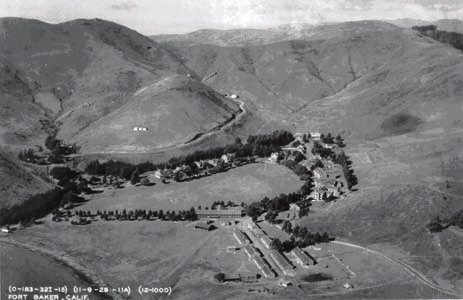
The parade ground is still there inside Murray Circle.6 It was the common ground of all three courses: remembered by Tracy as part of the Sausalito Golf Club's links, home to three of 's battle-named holes in 1924, and, by the 1947 caption, part of the lost WPA course.32,38,33
Notes to Chapter V (38 sources)
- Army and Navy Journal, April 17, 1937, p. 694. view source ↗
- “Golfers Invited TO Visit Course AT Fort Baker,” Sausalito News, Oct. 29, 1937. view source ↗
- “Railroad News,” Sausalito News, June 27, 1930. view source ↗
- “Cl SH Walker,” Sausalito News, Feb. 22, 1935. view source ↗
- “Under Way At Last,” Sausalito News, Nov. 5, 1937. view source ↗
- National Park Service, Cultural Landscape Report for Fort Baker, Golden Gate National Recreation Area (2005). view source ↗
- “Forts Baker, Barry to Be Rehabilitated,” Sausalito News, Sept. 1, 1938. view source ↗
- “FT. Baker Golf Club Notes,” Sausalito News, March 18, 1938. view source ↗
- “Free Golf Lessons At Fort Baker Club,” Mill Valley Record, April 15, 1938. view source ↗
- “Advantages of Baker Golf Course Listed,” Sausalito News, July 6, 1939. view source ↗
- “Golf Course At Fort Baker Offers New Practice Ranjje,” Sausalito News, April 22, 1938. view source ↗
- “FT. Baker Golf C Ourse Open TO Marin Use,” Sausalito News, Sept. 1, 1938. view source ↗
- “Seen and Heard About Town,” Sausalito News, Sept. 1, 1938. view source ↗
- “Local Residents Are Invited To Play Coif on Fort Baker Course,” Sausalito News, Nov. 17, 1938. view source ↗
- “The Chamber of Commerce Hears a Noted Speaker,” Sausalito News, Oct. 4, 1924. view source ↗
- “An Opportunity for Sausalito,” Sausalito News, Nov. 17, 1938. view source ↗
- “Fort Baker Opens Golf Course Soon,” Sausalito News, March 30, 1939. view source ↗
- “Invitation to Golf Fans Offered Here,” Sausalito News, April 6, 1939. view source ↗
- “Golf Club Plays Today AT M. V.,” Tamalpais News, April 21, 1939. view source ↗
- “Locey Wins First Golf Tourney,” Tamalpais News, April 14, 1939. view source ↗
- “Ft. Baker Golf Club Sponsors Tam High Team Officers Extend Privileges to Budding Golfers,” Sausalito News, April 27, 1939. view source ↗
- “Marin County Boys May Use Fort Baker Course Free,” Sausalito News, Feb. 7, 1925. view source ↗
- “Fort Baker Golf Course Opens Soon Plan Gala Celebration For Opening of Local Course July 9,” Sausalito News, June 15, 1939. view source ↗
- “Anchored Barge IS Floating Tee For U. S. Army Golfers,” SPDN, March 20, 1926. view source ↗
- “Public Invited To Foit Baker Golf Day,” Mill Valley Record, June 27, 1939. view source ↗
- “‘Open House” Order OF Day For Opening OF FT. Baker Golf Course Exhibition Matches, Inspection Trips, Band Concert Scheduled; Army Chiefs ill Be Honored,” Sausalito News, July 6, 1939. view source ↗
- “Army Officials Sliest at Golf GourseOpeniii",” Sausalito News, June 29, 1939. view source ↗
- “New Commandant at Two Marin Forts,” Mill Valley Record, June 20, 1939. view source ↗
- “Another Opportunity at Our Door,” Sausalito News, July 13, 1939. view source ↗
- “The M. B. Gibsons Sail for Missouri Aboard Republic,” Sausalito News, July 20, 1939. view source ↗
- Army and Navy Journal, July 8, 1939, p. 1063. view source ↗
- Jack Tracy, Sausalito, Moments in Time (Windgate Press, 1983), p. 65. view source ↗
- Sausalito News, May 22, 1947. view source ↗
- “tons Are Revealed for 18-Hole Golf Course in Marin County Golf Pro Says "Chances Good" To Have Course Before 1950; Would be North of San Rafael,” Mill Valley Record, Sept. 2, 1949. view source ↗
- “Across The Sports Desk,” Healdsburg Tribune, Sept. 26, 1957. view source ↗
- “Page 6,” Pacific Rural Press, Sept. 26, 1957. view source ↗
- National Park Service, “Fort Baker,” Golden Gate National Recreation Area (nps.gov), accessed Nov. 2026. view source ↗
- “Fort H Golf Club Has AH Unique Coe,” Sausalito News, Jan. 9, 1926. view source ↗