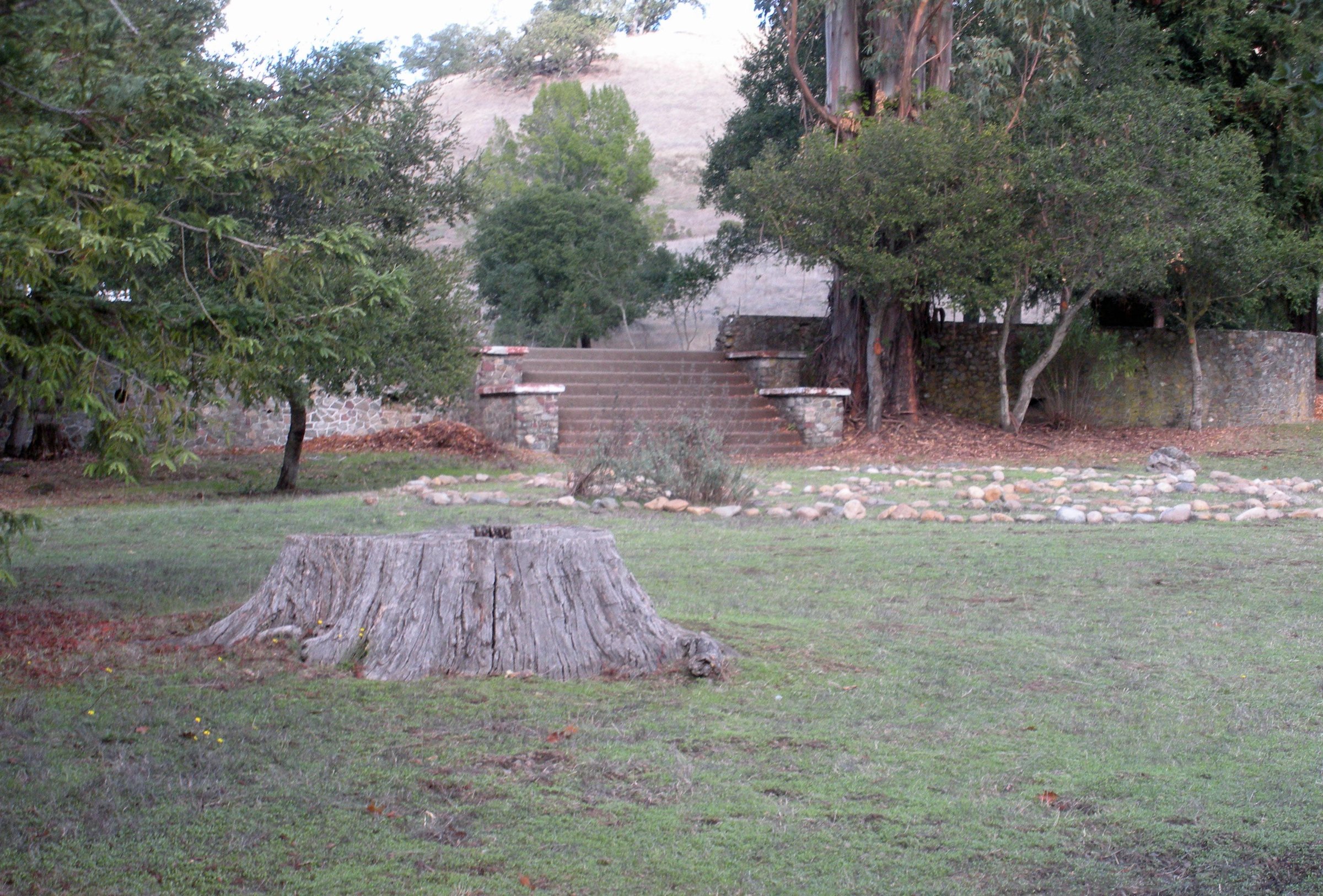
The Hotalings' Sleepy Hollow
The Old Dutton Ranch
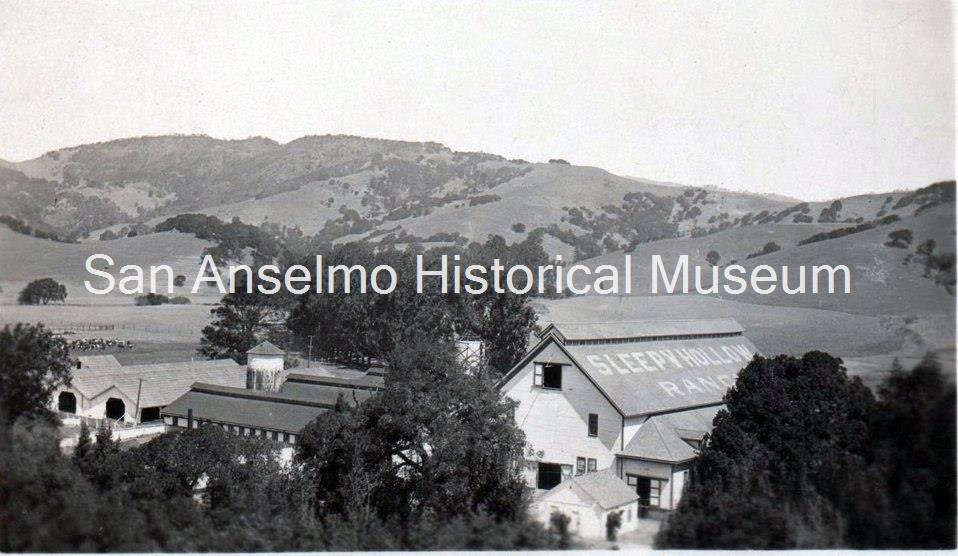
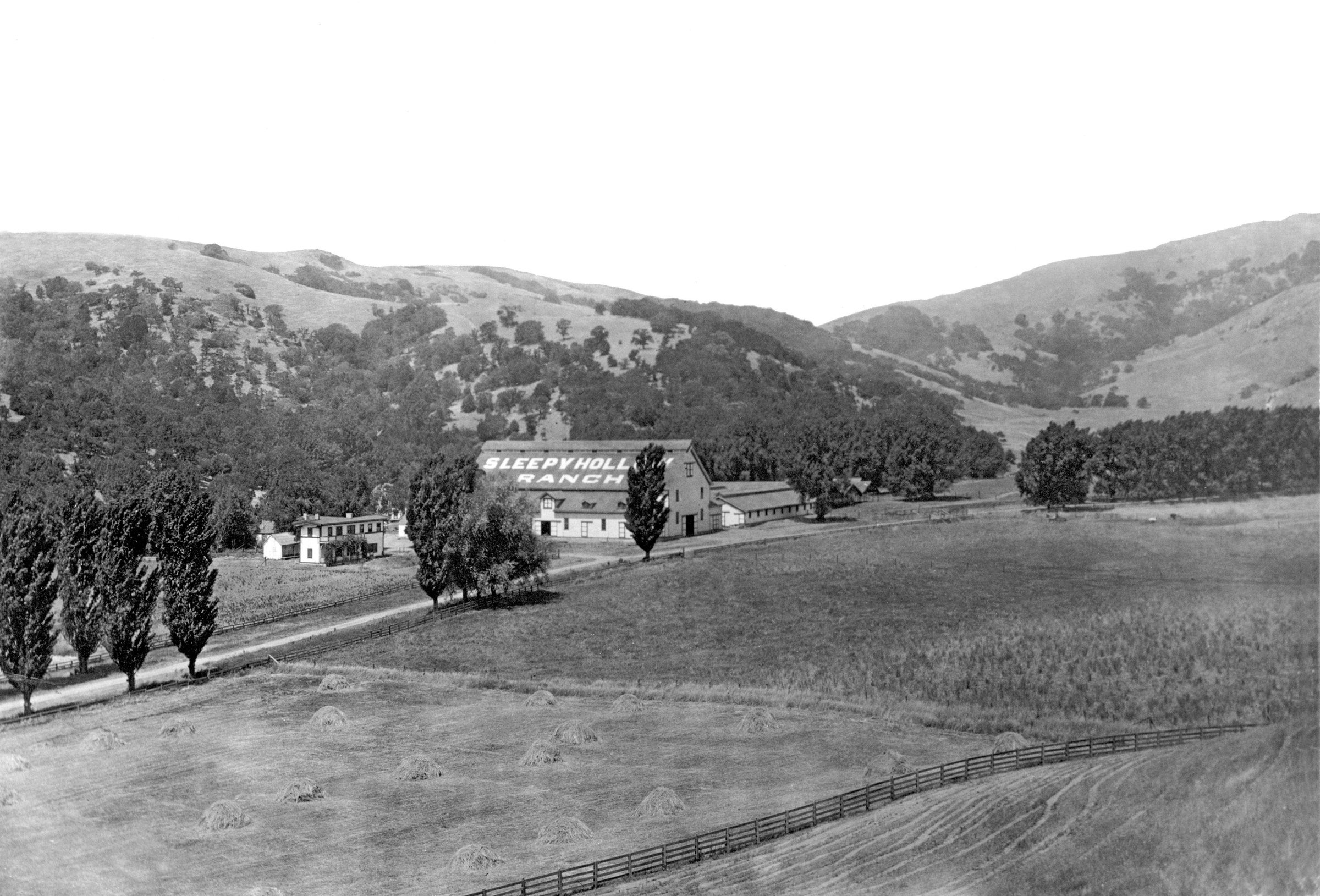
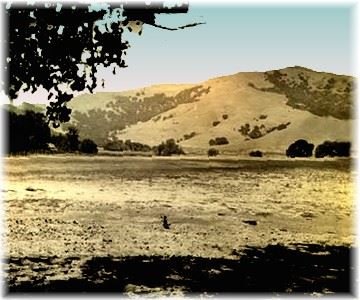
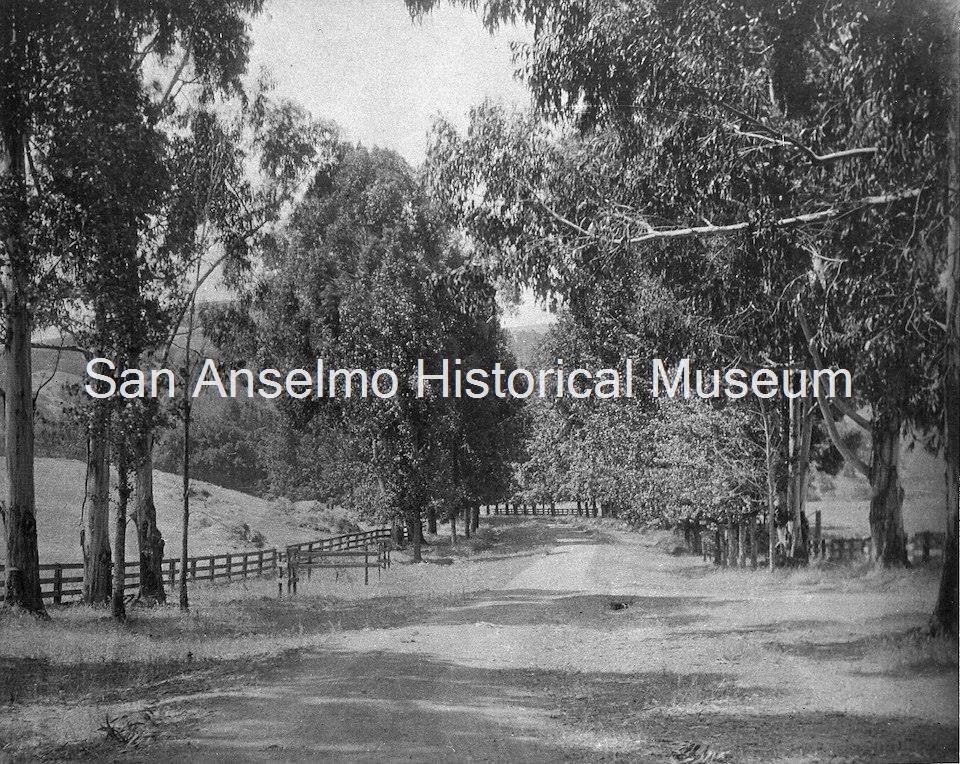
Long before anyone carried a golf bag up Butterfield Road, the valley at its head was cattle country, part of the Mexican land grant Rancho Cañada de Herrera, given to Domingo Sais in 1839 and leased by his son Pedro to a dairyman named Harvey Butterfield.1 The wagon road to "the old Butterfield place" became Butterfield Road.2,1 By 1920 the papers called it "Sleepy Hollow ranch, formerly known as the Dutton ranch."3,4
The land then passed to , the San Francisco whiskey merchant, in 1887 or 1889; no newspaper we have found records the sale.5,6,1 By the end of the century it belonged to the Company, held in quarter shares by his widow Lavinia, his sons Richard and Frederick, and Ella K. Hotaling, widow of the eldest son.7 In 1904 that company sold the ranch to a second family corporation, the Hotaling Estate Company.4
The road itself was a dead end, and a pretty one. In 1912 the San Anselmo Herald counted it among Marin's "blind roads," running two miles from the Fairfax road through country like the Kentish Downs and stopping at the Hotaling ranch.8 The valley kept its quiet. It would be the setting for a rich man's country house, a famous dairy, a string of resort schemes, and eventually a golf course.
Dick Hotaling's Country Place
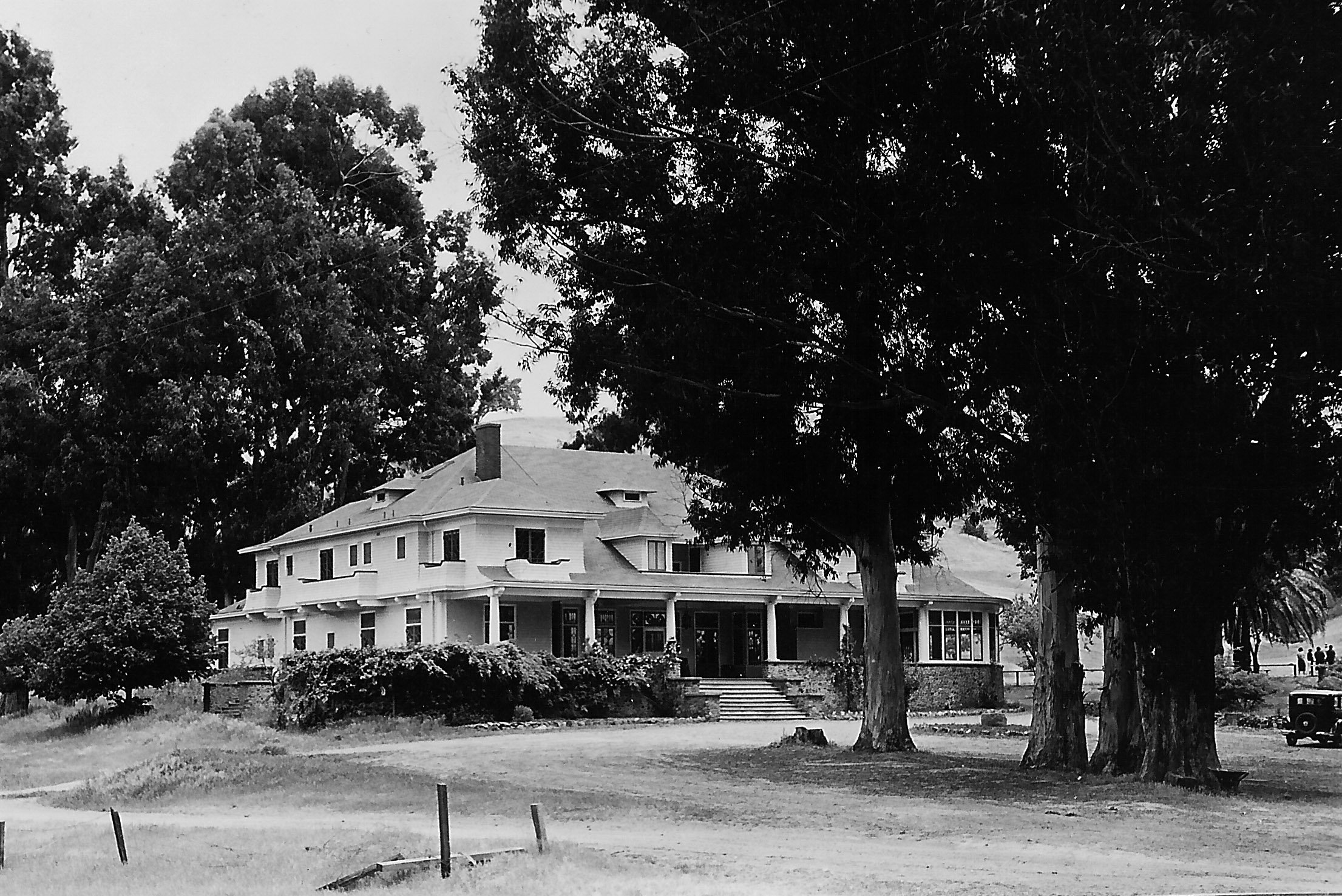
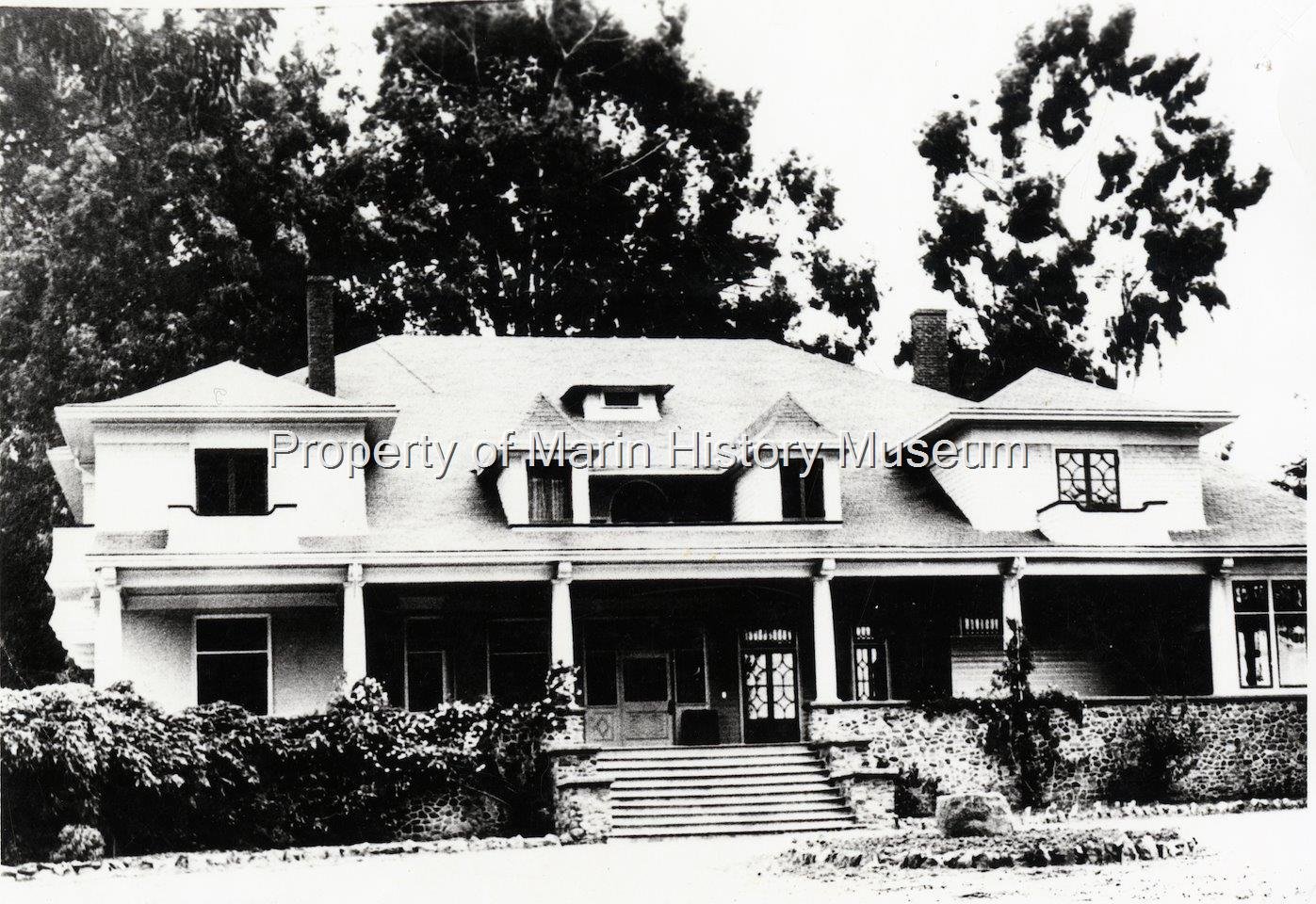
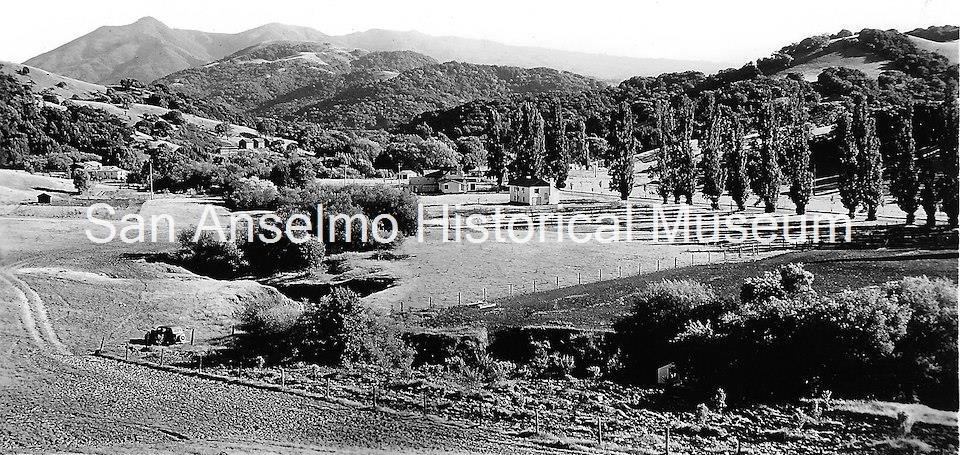
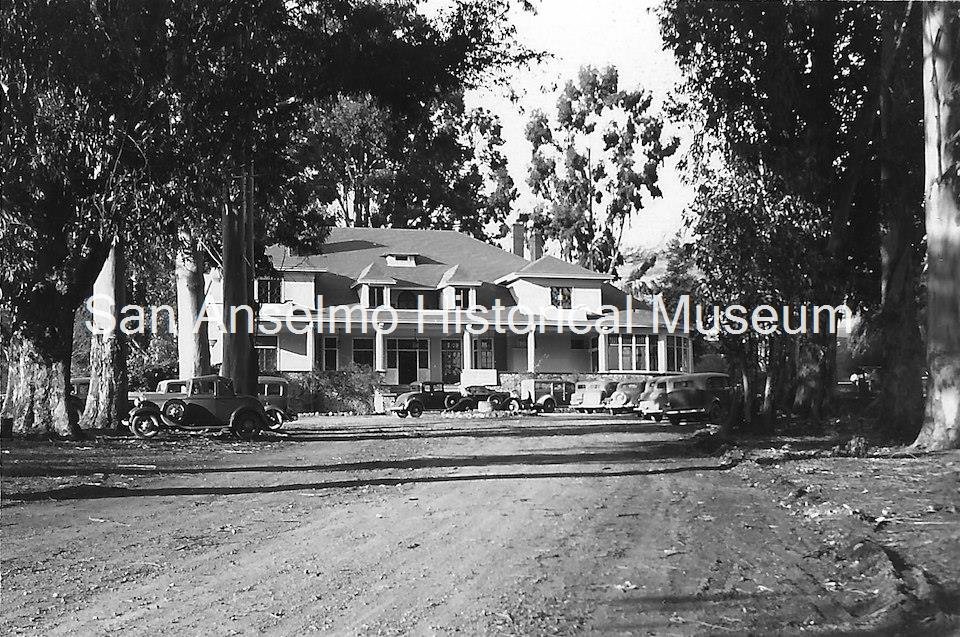
The man who made the valley famous was , known as Dick, a clubman and amateur Shakespearean actor who never married.9,10 In December 1900 the Marin Journal reported that he was "erecting a spacious residence on the 'Sleepy Hollow' tract," with suites each fitted with its own bath, a fountain, and a lake "well stocked with speckled trout."11 Its architect was probably Edward L. Van Cleeck of Santa Cruz, to whom Hotaling had given "the magnificent residence and stables he erected at Sleepy Hollow."12 That house would one day serve as the golf clubhouse, and its steps and foundation still stand at San Domenico School. The name, borrowed from Washington Irving, first appears in print with it.11,13
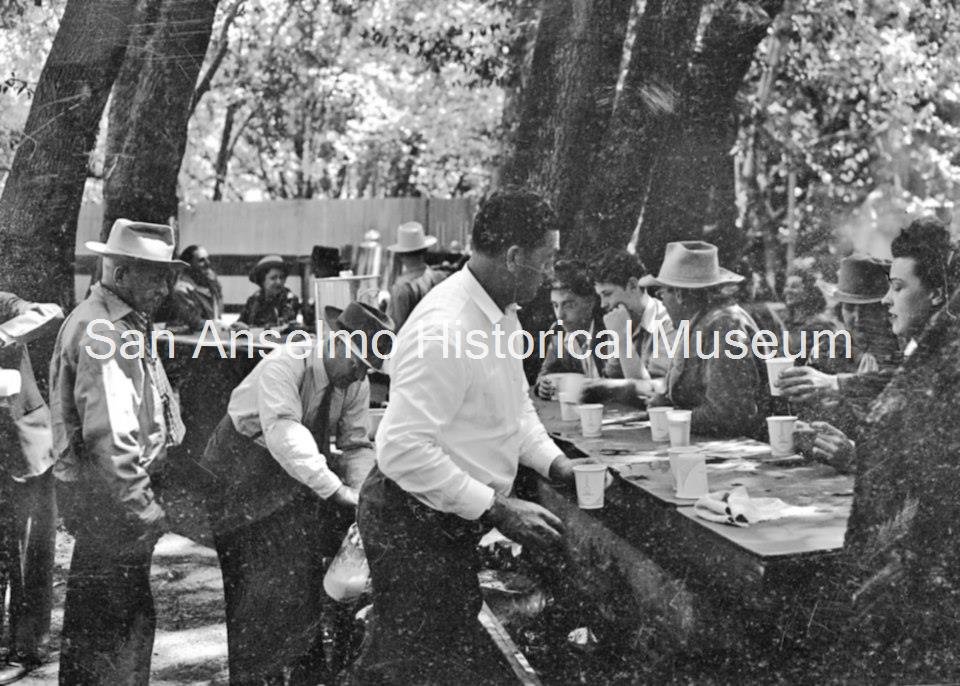
Richard's house parties became a fixture of the society pages. Over the Fourth of July in 1902 "the days and nights passed in a round of merriment."14 The Wasp wrote in 1904 that Dick "often wears a sweater about the streets," and "his hobby is 'Sleepy Hollow.'"15 Once he ordered guests to dinner in fancy dress without leaving the house; one woman made a gown from the drawing-room lace curtains.16 At Sleepy Hollow, a 1911 essay said, "guests come and go constantly."17
"His hobby is 'Sleepy Hollow,' his beautiful country place in San Anselmo."
It was also a family house. Ella and her daughter Jane spent summers there, and Jane gave her own house parties at the ranch.18,19,20 Lavinia later allowed that she might have called it "Dick's home."21
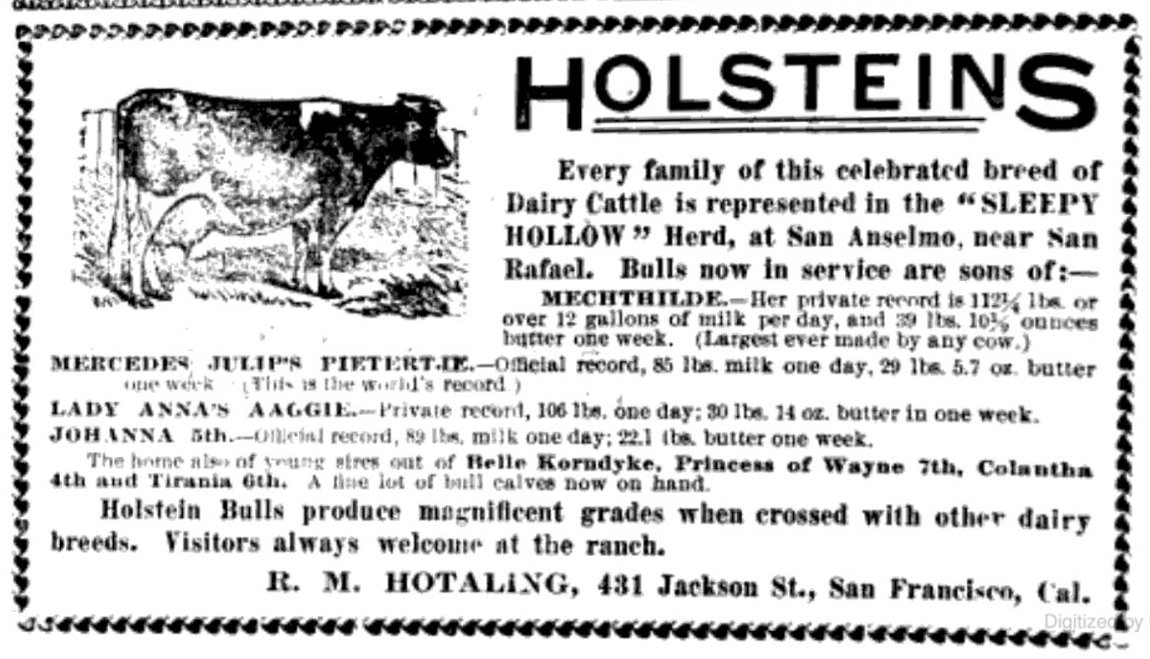
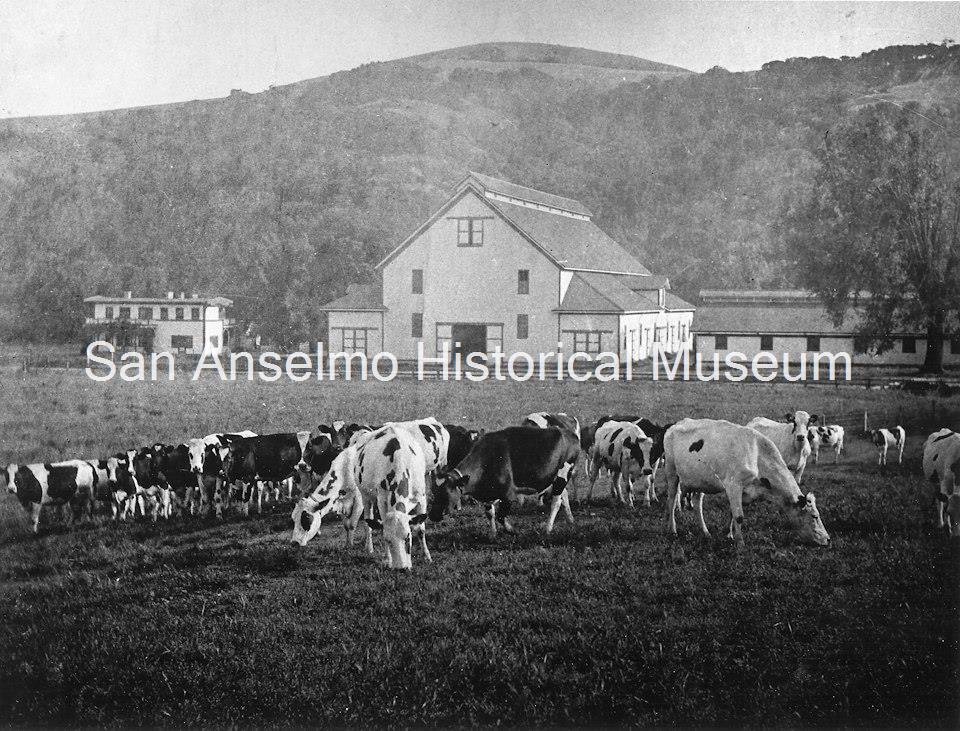
The Marin Journal's New Year's feature for 1903 gives the best picture of the place. No hunting was allowed, and pigeons crowded onto the owner's shoulders. Above all, Hotaling "prizes, most of all, his herd of select Holstein cattle, each one of which he personally knows and has, for him or her, a pet name." His sister had sent a dozen silver cowbells, each tuned to a note of the scale.22
The Most Famous Cows in Marin
The herd was more than a hobby. By 1901 Hotaling was advertising Holstein bulls from his "Sleepy Hollow" herd, and in 1904 he won three prizes at the State Fair.6,23 He and his manager, Mr. Davis, had at one time bred the world-record Holstein cow.24 The dairy was "known all over the world," with cows shipped to China, Japan and India.8
Then Richard stepped back. "Mr. Hotaling's business was so active that he determined to rent his ranch and sell his cattle," and the lease went to the Herzogs of San Rafael.24 was a merchant who would soon be the city's mayor.25,26 He was probably there from about 1906, though the earliest firm evidence is from September 1909.27,28,29
The first year went badly. Herzog tried to run the herd "with cheap help" and fell $3,000 behind, so "Mr. Davis was brought back and a certified dairy established."24 was still running it in 1924.30 Certification meant tuberculin testing, concrete floors, whitewash four times a year, and milkers in clean laundered suits.24 By June 1911 the Herzog company was selling certified milk "from Sleepy Hollow Ranch."31
The dairy made Sleepy Hollow a public name in a way Richard's parties never had. The Marin booth at the 1915 Exposition hung a painting with "a realistic view of Sleepy Hollow ranch."33 In 1917 the Call wrote that " owns the Sleepy Hollow ranch at Fairfax."34 He didn't. The ranch was still Hotaling property, and Richard was still listed at "Sleepy Hollow Ranch" in 1915.35 Not everything was idyllic: in 1913 the San Anselmo Woman's Improvement Club asked Herzog to help with the mosquitoes that hatched by the millions in the ranch creek.36,37
Mother Against Son
For almost two decades the arrangement held. It broke apart in a family quarrel.
At the end of October 1918 sued Richard to recover 2,500 shares of family stock; he called it "the best press-agent story of the year."38 Two weeks later the family sued to quiet title to the ranch itself.39 Richard held an 1899 deed to Sleepy Hollow, long kept unrecorded.40,41 He said it had always been meant as his home. His mother said it had been an emergency measure, in case Ella married a German nobleman.42,43 Meanwhile the Hotaling Estate Company had paid the taxes and spent some $106,000 improving the ranch.44,40
Richard's answer to his mother was read in court. "'Sleepy Hollow' is mine and I shall keep it," he wrote, for Anson's children, Jane and George.45
"No, mother, you are wholly wrong, 'Sleepy Hollow' is mine and I shall keep it."
In November 1919 Lavinia won back her shares.42 The Marin trial ran from 10 November to 20 December 1920 and aired the family's quarrels in public; Fred said he had been "dominated body and soul" by his brother.41,46 On 30 April 1921 Judge Butler ruled the deed invalid, because Richard, one of a bare quorum of three directors, had voted for a transfer to himself.41,47 Richard appealed. On 13 March 1924 the Supreme Court ruled that the ranch belonged to Lavinia, Fred and the Hotaling Estate Company, "and therefore is to be shared by the other heirs."43,48,5
A Ranch Without an Heir
In September 1923 a great fire swept down to the rear of the ranch, and green lawns saved "the residence buildings on Sleepy Hollow ranch."49,50
The feud reached the papers once more in February 1925, with an alleged plot against Lavinia and Fred; Richard denied any part in it, and a grand jury later cleared him.51,52
The fight ended in 1925 with a compromise dividing the family's holdings equally among Lavinia, Richard, Fred and Ella.10 In July the Hotaling Estate Company sold the ranch to the , 1,560 acres for "nearly $200,000," for five-acre homesites "with golf links and club house in the center."27,53 Herzog, with 300 cows in the valley, was given notice to vacate.53,27
Richard died in San Francisco on 14 November 1925, aged 57.52,10 When Lavinia died in 1929, her obituary said he had "passed much of his time at his famous Sleepy Hollow ranch."10
His parties were over, but the house survived, along with the barns, the poplars and the long open fields Herzog's cows had grazed. Those fields would be dug up for one golf course in 1925 and drawn up for another in 1929, and they finally opened as a public links in the 1930s, with 's mansion as the clubhouse.
Notes to Chapter I (53 sources)
- https://www.marinhistory.org/blog/post-54/ view source ↗
- San Anselmo Historical Museum, Butterfield Road, Catalog No. 0273. view source ↗
- “Around The Bay Region 4.,” Mill Valley Record, Nov. 20, 1920. view source ↗
- “Battle Opens For Hotaling Ranch,” Marin Journal, Nov. 11, 1920. view source ↗
- “Page 22,” Oakland Tribune, March 23, 1924. view source ↗
- https://sananselmohistory.org/articles/sleepy-hollow-ranch-in-1904/ view source ↗
- “S. F. Greets U. S. Commerce Leaders Mother Shis HOTALIN6 HD Trust,” San Francisco Call, Aug. 4, 1919. view source ↗
- “Page 4,” San Anselmo Herald, March 16, 1912. view source ↗
- “Page 1,” Napa Journal, Aug. 6, 1919. view source ↗
- “Page 1,” Santa Rosa Press Democrat, Jan. 6, 1929. view source ↗
- “Marin County Items.,” Marin Journal, Dec. 27, 1900. view source ↗
- “Page 1,” Santa Cruz Surf, May 11, 1907. view source ↗
- San Anselmo Historical Museum, Sleepy Hollow Dairy Cows, Catalog No. 0278. view source ↗
- “Society's Summer Outing,” San Francisco Call, July 13, 1902. view source ↗
- “Page 1,” Evening Sentinel (Santa Cruz), May 31, 1904. view source ↗
- “Page 3,” Evening Sentinel (Santa Cruz), June 28, 1904. view source ↗
- “Society by the Outsider,” San Francisco Call, Aug. 27, 1911. view source ↗
- “The-:smart Set,” San Francisco Call, Sept. 7, 1909. view source ↗
- “Events of Local Note,” Marin Journal, Sept. 8, 1910. view source ↗
- “Page 3 Advertisements Column 3,” Morning Press (Santa Barbara), Dec. 4, 1912. view source ↗
- “Swots OF «0W Denied 0) Mother,” San Francisco Call, Aug. 19, 1919. view source ↗
- “AN Ideal Ranch IS "Sleepy Hallow.",” Marin Journal, Jan. 1, 1903. view source ↗
- “Local News Happenings,” Marin County Tocsin, Sept. 10, 1904. view source ↗
- “Sleepy Hollow Certified Dairy.,” Pacific Rural Press, May 25, 1912. view source ↗
- “The Candidates Have Circulated Petitions,” Marin Journal, March 11, 1915. view source ↗
- “Theasurer's Report ON County Funds,” Marin County Tocsin, Oct. 16, 1915. view source ↗
- “Page 1,” San Anselmo Herald, July 24, 1925. view source ↗
- “Page 4,” Petaluma Argus-Courier, Oct. 15, 1926. view source ↗
- “Documents Filed For Record AT The Recorder's Office,” Marin Journal, Sept. 16, 1909. view source ↗
- “ÄAKiN COrXTY Aguiculitke Prizes Won in Cheese-Making; Milk ifaies High in Quality,” Mill Valley Record, Dec. 20, 1924. view source ↗
- “Miscellaneous Records,” Marin County Tocsin, June 17, 1911. view source ↗
- “"Marin County Day" Draws Thousands TO Exposition And California Building,” Marin County Tocsin, March 13, 1915. view source ↗
- “IT Was All Marin,” Marin Journal, March 18, 1915. view source ↗
- “Pretty Novato Girl IS Charming Bride,” Marin Journal, Sept. 13, 1917. view source ↗
- “Page 4,” San Anselmo Herald, Sept. 24, 1915. view source ↗
- “Improvement Club Holds Meeting,” Marin Journal, Feb. 13, 1913. view source ↗
- “Page 3,” San Anselmo Herald, Feb. 15, 1913. view source ↗
- “Page 6,” Santa Cruz Evening News, Nov. 1, 1918. view source ↗
- “Another Suit Started In Hotaling Estate,” San Francisco Call, Nov. 16, 1918. view source ↗
- “Hotaling Trial Comes To Close,” Marin Journal, Dec. 2, 1920. view source ↗
- “Mrs. Hotaling Wins Sleepy Hollow Suit,” Marin Journal, May 5, 1921. view source ↗
- ““Dick” Totaling Loses $1,000,000 Suit TO Mother Judge Hun! Restores Shire IH Fortune,” San Francisco Call, Nov. 17, 1919. view source ↗
- “Page 2,” Oakland Tribune, March 13, 1924. view source ↗
- “IS. Hqtaling IS Shocked B¥ Son's Word,” San Francisco Call, Aug. 7, 1919. view source ↗
- “Spri*s Letter Tells Claim *.*'• • • • O Upon Ranch,” San Francisco Call, Nov. 30, 1920. view source ↗
- “Mrs. Homing TO Take Stir IN Reed Suit,” San Francisco Call, Nov. 23, 1920. view source ↗
- “Hotaling Loses $250,000 Ranch,” Sacramento Union, May 1, 1921. view source ↗
- “Page 1,” Santa Rosa Press Democrat, March 14, 1924. view source ↗
- “County's Largest Eire Devastates Large Area,” Sausalito News, Sept. 22, 1923. view source ↗
- “Page 9,” Oakland Tribune, Sept. 18, 1923. view source ↗
- “Richard Hotaling Denies Any Part In Death Plotting,” Stockton Independent, Feb. 27, 1925. view source ↗
- “Page 1,” Oakland Tribune, Nov. 15, 1925. view source ↗
- “Page 7,” Santa Rosa Press Democrat, July 22, 1925. view source ↗
Castles in the Hollow
Notice to Vacate
In the third week of July 1925 the San Francisco papers carried a rumor Marin had waited years to hear. The Sleepy Hollow ranch, "long one of the bones of contention in the many Hotaling family rows," was to become "a highly exclusive residential tract."1,2 The buyer was said to be the , at $250,000 for 1,600 acres, though Lang would admit only that "negotiations have been under way."1,2 The San Anselmo Herald had 1,560 acres for "nearly $200,000."3
The plan was the same in every version: five-acre homesites, with a golf links and clubhouse.1,4 The Herald pictured "higher class subdivisions, with golf links and club house in the center," under a full view of Mount Tamalpais.3 So golf entered the Sleepy Hollow story at the very first announcement, nine years before anyone hit a ball there.
The news was harder on the people working the land. Sigfried K. Herzog, a former mayor of San Rafael, had run the Sleepy Hollow Certified Dairy there for two decades, and he was given notice to vacate.5,1 The Mill Valley Record noted that the dairy had "supplied children and hospitals with the best of certified milk."5
The dairy did not go quickly. In April 1926 neighbors complained about the smell and the discolored creek, traced to drainage from the dairy's silos.6 That October the Herzog company bought the 2,200-acre Roseland ranch near Lakeville in Sonoma County, having been "unable to find in Marin county a farm and lands suitable" for the herd.7,8 In May 1927 the "famous Sleepy Hollow herds" were still waiting for the Lakeville barns, and by March 1928 was "of the Sleepy Hollow Ranch in Sonoma County."9,10 The herd probably moved north in 1927 and took its name with it.
Ground Broken
The golf course came first, at least on paper. In late September 1925 the Mill Valley Record reported that 's purchase had closed at $250,000, and "a golf course will be developed on the tract immediately."11 A few days later the Santa Rosa Press Democrat said that John Clarke, "one of the famous golf course constructors in the country," had supervised the breaking of ground for a course on the ranch.12
That paragraph is all the papers we have say about Clarke. No later account mentions him or his course. October 1925 is the earliest golf work at Sleepy Hollow we can document, but it may have gone no further than a ceremonial plowing.
Six weeks later died in San Francisco, on 14 November 1925.13,14 He had "spent much of his time on his Sleepy Hollow ranch in Marin county, only recently sold."13 His mother, Lavinia, died in January 1929.15 The Hotaling era in the valley was over.
The Del Monte of Marin
During 1926 the plan grew much larger. In July the Herald reported that Lang Realty was negotiating to sell 1,100 of its 1,600 acres to an Eastern syndicate for a resort "on the order of Del Monte," with a 200-room hotel, a 25-acre lake and "golf courses," plural.16 In August the Press Democrat reported a sale of 1,609 acres to "an eastern syndicate," and the Sausalito News promised a "Del Monte of Marin county," the Sleepy Hollow Inn and Country Club.17,18
The trade press supplied a name: ", representing Eastern capital," had taken an option on the tract, planning $2,000,000 for a hotel, a golf course, a polo field and an "artificial lake for boating and bathing."19 Note what these sources call the buyers. Every one written at the time says "eastern." None names Chicago.
The county prepared for the boom, taking up a petition in July 1926 to improve Butterfield Road out to "the former dairy ranch made famous by the Hotaling family."20 In March 1927 negotiations for the hotel, golf course and lake were again "reported to be in progress."21
One golf architect of the first rank may also have walked the ground. The modern MacKenzie Chronology says that around mid-1927 Dr. Alister MacKenzie and Robert Hunter were apparently asked to look at a course site at the Sleepy Hollow ranch, then planned by Lang Realty as a country club with a hotel and an 18-hole course.22 Its evidence is a 1935 Chronicle article quoting MacKenzie on the terrain: "No one could miss on ground like this."22 We have not seen that article, and no MacKenzie plan for Sleepy Hollow is known.
By the end of 1927 it was no longer clear who owned the ranch. A Novato rancher sued , saying Boadway had falsely claimed his company owned Sleepy Hollow, which in fact "is owned by Walter Graf."23 Boadway was probably the "O. A. Broadway" of 1926, but that is an inference, and Walter Graf appears nowhere else.
Seven Stories at the Head of the Valley
In October 1928 the Architect and Engineer reported that H. C. Baumann had completed plans for "a $2,000,000 country club and hotel project" on "six hundred acres, formerly owned by the Hotaling Estate," with a seven-story hotel, golf links and a swimming pool.24 The site had shrunk from 1,600 acres to 600.
On 30 November 1928 Thebo, Starr & Anderton won the contract for a $1,250,000 "seven-story and basement, steel frame and concrete hotel building," for a corporation financed by the Western Management and Finance Company.25,26 In April 1929 construction was to begin "within forty days."27
Then the golf course. On 12 May 1929 the Oakland Tribune reported that William Watson, "the well known Los Angeles golf course constructor," had won the contract for an 18-hole course of 6,640 yards on which "the creek will be crossed 18 times during the play," plus a supplementary nine.28
"There will be a 6640 length 18 hole course in which the creek will be crossed 18 times during the play."
That June the Herald said "confidential information" indicated the hotel project was "practically assured."29
The Quiet Years
After June 1929 the papers we have stop mentioning the hotel. We have found no report of ground broken or of Watson's crew arriving, and no notice of cancellation. The stock market crashed that October.
The years from 1930 to 1933 are almost blank in our record; "Sleepy Hollow" now usually meant Herzog's dairy at Lakeville.30 In early 1933 California Arts & Architecture printed a photograph of "the hospitable old Hotaling place at Sleepy Hollow," so the mansion still stood.31
Later accounts made the story grander. In 1943 the Argus-Courier recalled a syndicate's "million-dollar hotel, a milelong lake and two golf courses," and in 1952 the Independent-Journal made the syndicate a Chicago one.32,33 The papers of the 1920s do not support Chicago; they name an "eastern" syndicate, Broadway's option, and a San Francisco-financed hotel corporation.17,19,25 The lake and the "golf courses" are real enough, though.16,28
In eight years the valley had been promised a golf links twice, a hotel several times, and a polo field and a lake at least once. When came looking in 1934, nothing announced since 1925 had been built, and the old Hotaling house still stood at the head of the valley.34,31
Notes to Chapter II (34 sources)
- “Page 7,” Santa Rosa Press Democrat, July 22, 1925. view source ↗
- “Marin Estate is Sold For Subdivision,” Healdsburg Tribune, July 22, 1925. view source ↗
- “Page 1,” San Anselmo Herald, July 24, 1925. view source ↗
- “Page 8,” Petaluma Argus-Courier, July 23, 1925. view source ↗
- “Sleepy Hollow Sold,” Mill Valley Record, July 25, 1925. view source ↗
- “Page 1,” San Anselmo Herald, April 7, 1926. view source ↗
- “Page 4,” Petaluma Argus-Courier, Oct. 15, 1926. view source ↗
- “Page 4,” Santa Rosa Press Democrat, Oct. 5, 1926. view source ↗
- “Page 9,” Petaluma Argus-Courier, May 5, 1927. view source ↗
- “Happenings Around The Bay,” Mill Valley Record, March 9, 1928. view source ↗
- “New Suburban Development,” Mill Valley Record, Sept. 26, 1925. view source ↗
- “Page 18,” Santa Rosa Press Democrat, Oct. 4, 1925. view source ↗
- “Page 1,” Santa Rosa Press Democrat, Nov. 15, 1925. view source ↗
- “Page 1,” Oakland Tribune, Nov. 15, 1925. view source ↗
- “Page 1,” Santa Rosa Press Democrat, Jan. 6, 1929. view source ↗
- “Page 1,” San Anselmo Herald, July 27, 1926. view source ↗
- “Page 2,” Santa Rosa Press Democrat, Aug. 20, 1926. view source ↗
- “Big Hotel Planned Fob Marvelous Marin,” Sausalito News, Aug. 28, 1926. view source ↗
- https://books.google.com/books?id=fmdKODO__agC&pg=RA10-PA12 view source ↗
- “Sleepy Hollow Improvement,” Mill Valley Record, July 24, 1926. view source ↗
- “Feature Page For Marin Attraction!) of County in Home Sites Are Set Forth,” Mill Valley Record, March 19, 1927. view source ↗
- MacKenzie Chronology (22nd rev.), 2025-01, p. 159 view source ↗
- “Page 1,” San Anselmo Herald, Dec. 9, 1927. view source ↗
- Architect and Engineer, 1928-10, v.95 no.1, p. 109 view source ↗
- “Page 5,” Santa Rosa Press Democrat, Dec. 6, 1928. view source ↗
- “Page 10,” Petaluma Argus-Courier, Dec. 5, 1928. view source ↗
- “Around The Bay,” Mill Valley Record, April 5, 1929. view source ↗
- “Page 62,” Oakland Tribune, May 12, 1929. view source ↗
- “Page 2,” San Anselmo Herald, June 21, 1929. view source ↗
- “Page 6,” Santa Rosa Press Democrat, Nov. 13, 1932. view source ↗
- California Arts & Architecture, 1933-02/03, v.43 no.2, p. 12-13 view source ↗
- “Page 10,” Petaluma Argus-Courier, April 15, 1943. view source ↗
- San Rafael Independent-Journal, 1952-09-20, Marin Magazine, p. M15-M16 view source ↗
- “Page 4,” San Anselmo Herald, Oct. 25, 1934. view source ↗
Polly Willard's Public Links
A Golfer Called Polly
Through the 1920s the old Hotaling ranch at the end of Butterfield Road had been a place where plans went to die. As the Independent-Journal remembered it in 1952, the land and buildings lay idle from the crash until the mid-1930s1. The man who finally put grass on the ground was a single San Francisco golfer with a nickname.
He was , called "Polly" by everyone in Bay Area golf, a San Francisco realty broker2. In 1927 he reached the semifinal of the Menlo Cup3, and that winter he was medalist in the first championship of the Harding Park Golf Club, losing the final to Ray Huntley4. He was a well-known public-course player who also knew how land was bought and sold.
On 21 October 1934 the Sacramento Union reported that was directing construction of an 18-hole layout called the Sleepy Hollow Golf and Country Club, to be finished in May5. Four days later the Marin Herald had the local version: a golf course on some 350 acres of the old Sleepy Hollow ranch, backed by , with dues low enough for any enthusiast. Options had been taken on the land, and an outright purchase would follow once a title search was done6. The paper also remembered that Harry Ballou had once proposed a municipal golf course for Marin as a war memorial, an idea the Depression had smothered6.
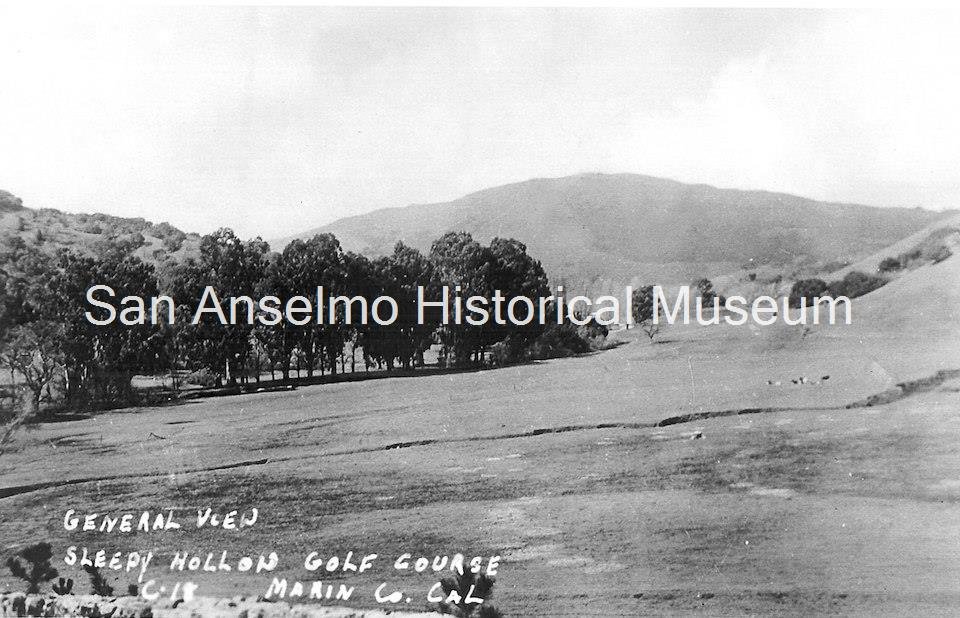
Within two weeks the numbers began to wander. The Petaluma Argus-Courier reported that Willard had started building a sporty 18-hole links on about 160 acres of the Hotaling estate, 6,666 yards long and costing close to $50,000, with the Hotaling mansion remodeled as a clubhouse and dining place. The ground was so suited to golf, the paper said, that only two of the eighteen greens would need to be built up artificially7. Two days later the Herald said he had acquired 100 acres for public links at a small green fee, and hoped to open the following June8. The likeliest reading is that the larger figure was the land under option and the smaller ones the playing ground, but no paper says so.
On 23 November the Mill Valley Record gave the venture its lasting name: the Sleepy Hollow Golf Course, the first public course ever built in Marin County, with Byrne-Cavendish in charge of construction9. Willard was described as the promoter of several of the most popular courses in the Bay region, though the papers never named them9.
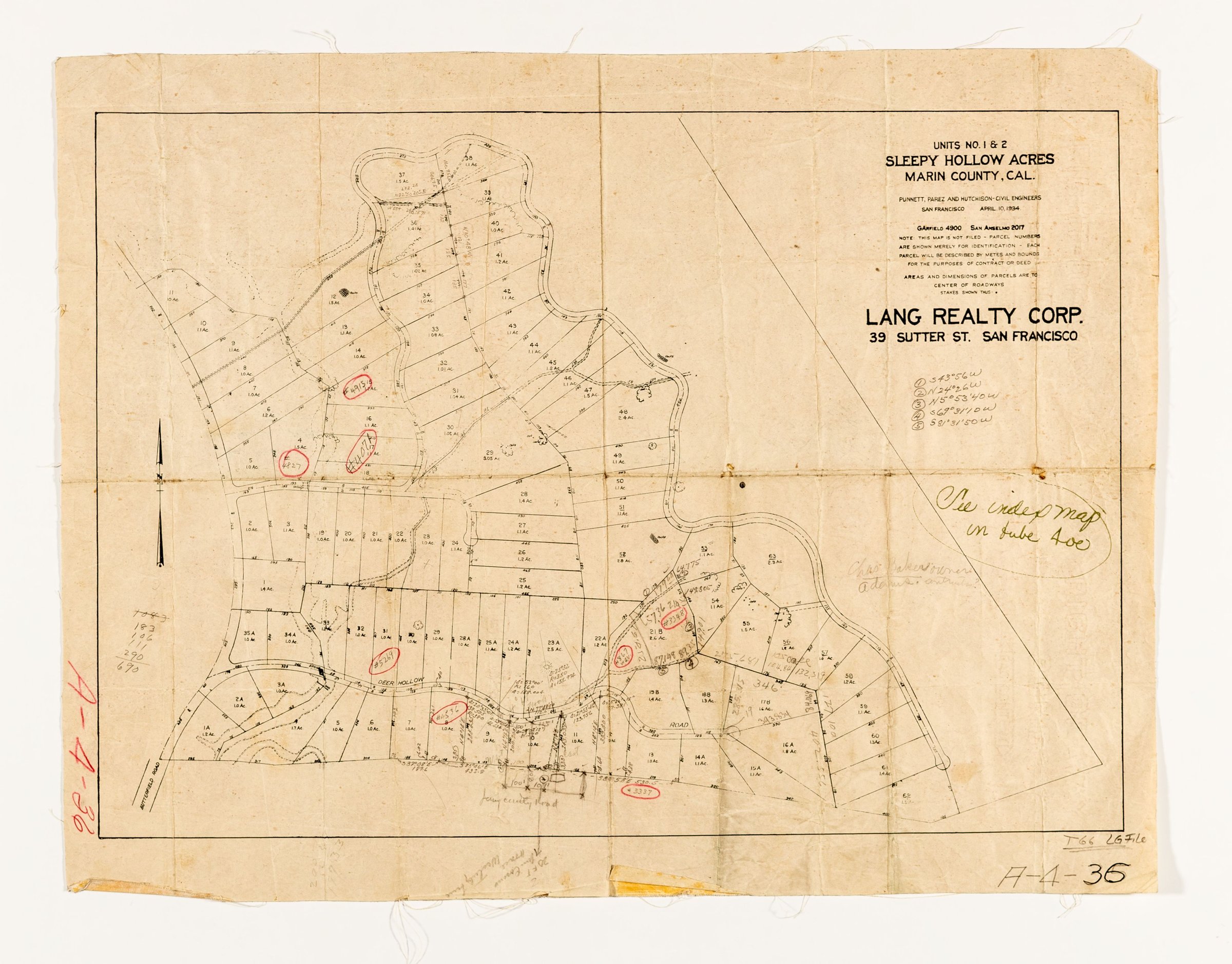
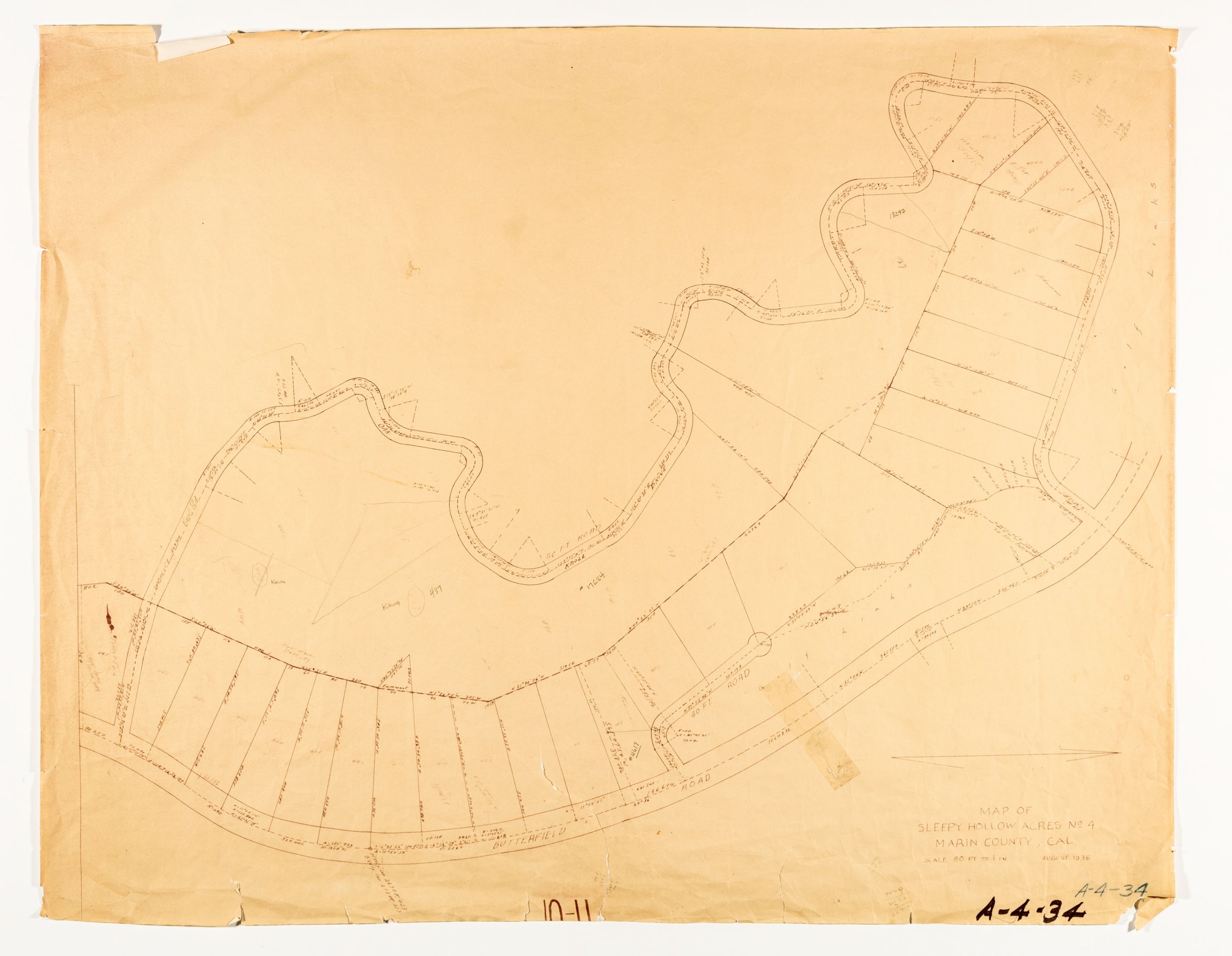
The lower valley was already being sold off in lots as Sleepy Hollow Acres10. Golf would be the attraction at the head of the valley, and houses would fill in below it.
The MacKenzie Chronology quotes a San Francisco Chronicle article of 15 February 1935 in which the late Dr. Alister MacKenzie said of the Sleepy Hollow ground: "No one could miss on ground like this."11 We have not seen the Chronicle page itself.
Greens on the Hotaling Meadows
On 5 June 1935 Willard told the Argus-Courier that thirteen of the eighteen greens were ready for seeding, and that the Hotaling mansion would be reopened as a gathering place for the people of the county12. The country house built for 's private parties was now promised to the public.
Grass needs water. In July 1935 Willard asked the Marin Municipal Water District for a more favorable contract to water eighteen greens and fairways13. In October he came back, saying the finished course would use 40 million gallons a year, asking for more time to complete it, and offering a letter guaranteeing a bond14. The papers do not say what the district decided. Water bills would come back to haunt the course. After that, the newspapers say almost nothing for six months.
Pay as You Play
On 23 April 1936 the state chartered Sleepy Hollow Properties, Inc., and the Argus-Courier announced that Marin was assured of its first pay-as-you-play course. The incorporators were Willard, and 15. Kaenel was a prominent San Rafael businessman and former chamber of commerce president; McLaughlin was a San Francisco attorney long active in golf15,16. All contracts to complete the 18 holes were signed, the first load of pipe for the water system was landed on the job, and the hope was to open by early September15.
The Herald described the whole project as a subdivision with a golf course at its center17. The Sausalito News said swanky country clubs were beyond the average wage earner, but such a person could find the price of an occasional game at Sleepy Hollow18. That was the promise of the place in a sentence.
Fire in the Hollow
On Saturday afternoon, 27 June 1936, a brush fire swept about 30 acres of Sleepy Hollow Acres. Firemen fought it with five-gallon cans of water, and Captain Robert "Bert" Meagor of the San Anselmo fire department, 27 years old, became separated from the others and was burned to death22,23. Authorities believed a small boy was setting grass fires along Butterfield Road for the thrill of watching the engines, and suspected him of riding a horse across the newly seeded greens24.
When the county fire chiefs met in Ross and stood in silence for Meagor, Kaenel promised special fittings so that any fire crew could tap the course's new water lines23. The pipe meant for the greens became a hydrant system for the hollow. The fires did not stop. Six acres in the Sleepy Hollow subdivision burned on 17 July25, and in late August a ten-acre grass fire burned right up to the edge of the new course before three departments with five engines stopped it26.
Meanwhile the opening date kept slipping, to 1 October27 and then to early October28. By late October the county firemen's association had booked its December meeting at the new clubhouse, the first sign of the building being used for anything29.
A Unit at a Time
The course opened in stages. On Sunday, 22 November 1936, a driving and practice green opened east of the old mansion, visible from what the Argus-Courier called the spacious circular cocktail lounge. All eighteen greens and fairways had been planted, and lockers, showers, a dining room and two bars were nearly finished inside the mansion30.
In December the first nine, east of the clubhouse drive, opened. The paper printed the card: a par-36 nine of 3,440 yards, opening with a 435-yard hole and with only one short hole, a 215-yard eighth31. The listed holes actually add up to 3,450 yards. It was a long, demanding nine, with seven par-4s, three of them over 400 yards. By 1940 the first hole had become a par 5, but no paper says what changed32. In March 1937 the Herald reported that the second nine had opened33, and that the first nine had been closed for a while to rest the turf. All eighteen holes were thrown open to the public on Sunday, 18 April 193734.
"it will be operated as a public links, not a private club."
The Mill Valley Record's notice is the most quoted and least reliable item of the story. It said the club would reopen under new ownership with Willard in charge, called it the second longest course in the United States, and gave it an actual nineteen holes, the last for settling ties35. The 6,666 yards was the planned length from 19347; by 1938 the Herald gave 6,50036. The mention of new ownership hints at a change over the winter that the papers never explain.
In May 1937 Marvelous Marin brought sixteen hundred University of California seniors over by ferry to play at Sleepy Hollow and the Marin Golf and Country Club37. Marvelous Marin had spent the spring preparing to put the county on the map before the Golden Gate Bridge opened33, and a public course in the old Hotaling meadows was exactly what it wanted to show visitors.
Sixty-Two and a Half Percent
The full course had been open less than three months when, on 15 July 1937, minority stockholders of Sleepy Hollow Properties, Inc. sued to remove Willard, who owned 62.5 percent of the stock, as a director and to have a receiver appointed38,39.
The complaint said the $30,000 course was operating at a loss, its debts were about $45,000, and the water district had demanded a $1,000 deposit and threatened to cut off service. Willard, it said, had refused the progressive policies urged by Kaenel and McLaughlin38,39. It also revealed that the course stood on a leasehold from the San Anselmo Holding Corporation38,39. In 1934 the Herald had written of options and an outright purchase6, and in 1936 the Sausalito News had congratulated Kaenel on acquiring the properties18. But the operating company did not own the ground under its greens, and the Herald never said who stood behind the San Anselmo Holding Corporation.
The plaintiffs, led by R. C. Doherty, included himself and three more Kaenels38. The man who had become the public face of Sleepy Hollow was suing to take control of it from the man who had first imagined it.
The golf part of the promise had come true: on the Sunday after the suit was filed, more than a hundred golfers played the course40. The business part had not, and that is where the next chapter begins.
Notes to Chapter III (40 sources)
- San Rafael Independent-Journal, 1952-09-20, Marin Magazine, p. M15-M16 view source ↗
- Los Angeles Times, 1924-07-13 view source ↗
- American Golfer, 1927-09, v.30 no.12, p. 54 view source ↗
- American Golfer, 1927-12, v.31 no.3, p. 41 view source ↗
- “Page 19,” Sacramento Union, Oct. 21, 1934. view source ↗
- “Page 4,” San Anselmo Herald, Oct. 25, 1934. view source ↗
- “Page 4,” Petaluma Argus-Courier, Nov. 6, 1934. view source ↗
- “Page 1,” San Anselmo Herald, Nov. 8, 1934. view source ↗
- “Public Golf Course,” Mill Valley Record, Nov. 23, 1934. view source ↗
- “Page 13,” Santa Rosa Press Democrat, Dec. 16, 1934. view source ↗
- MacKenzie Chronology (22nd rev.), 2025-01, p. 159 view source ↗
- “Page 7,” Petaluma Argus-Courier, June 6, 1935. view source ↗
- “Water District “Not Interested” IN Sale OF Phoenix Lake,” Mill Valley Record, July 19, 1935. view source ↗
- “Page 3,” San Anselmo Herald, Oct. 17, 1935. view source ↗
- “Page 10,” Petaluma Argus-Courier, April 24, 1936. view source ↗
- “Public Golf Course,” Sausalito News, April 24, 1936. view source ↗
- “Page 6,” San Anselmo Herald, April 30, 1936. view source ↗
- “"C K”,” Sausalito News, May 1, 1936. view source ↗
- https://babel.hathitrust.org/cgi/pt?id=mdp.39015080091252&seq=17 view source ↗
- https://babel.hathitrust.org/cgi/pt?id=mdp.39015086613059&seq=235 view source ↗
- GolfClubAtlas forum, modern view source ↗
- “Page 6,” Red Bluff Daily News, June 29, 1936. view source ↗
- “Page 1,” San Anselmo Herald, July 9, 1936. view source ↗
- “Page 1,” Petaluma Argus-Courier, July 4, 1936. view source ↗
- “Page 6,” Petaluma Argus-Courier, July 20, 1936. view source ↗
- “Page 5,” Petaluma Argus-Courier, Aug. 29, 1936. view source ↗
- “Page 1,” San Anselmo Herald, July 16, 1936. view source ↗
- “Page 2,” San Anselmo Herald, Sept. 17, 1936. view source ↗
- “Page 5,” Petaluma Argus-Courier, Oct. 23, 1936. view source ↗
- “Page 4,” Petaluma Argus-Courier, Nov. 21, 1936. view source ↗
- “Page 4,” Petaluma Argus-Courier, Dec. 4, 1936. view source ↗
- “Page 8,” San Anselmo Herald, June 6, 1940. view source ↗
- “Page 5,” San Anselmo Herald, March 11, 1937. view source ↗
- “Page 1,” San Anselmo Herald, April 15, 1937. view source ↗
- “Sleepy Hollow Golf Club Opens Sat.,” Mill Valley Record, April 16, 1937. view source ↗
- “Page 5,” San Anselmo Herald, Dec. 8, 1938. view source ↗
- “Page 8,” San Anselmo Herald, May 20, 1937. view source ↗
- “Page 4,” Petaluma Argus-Courier, July 17, 1937. view source ↗
- “Demand Removal of Golf Club Director,” Mill Valley Record, July 23, 1937. view source ↗
- “Page 8,” Petaluma Argus-Courier, July 20, 1937. view source ↗
Out of the Rich Folks' Class
Mr. Kent Takes Charge
By the middle of July 1937 the new course at the head of Butterfield Road had eighteen good holes, a mansion for a clubhouse, and a balance sheet nobody wanted to read. Minority stockholders had gone to court to pry out of the company, saying the course was losing money, owed about $45,000, and faced a $1,000 water deposit.1,2
On Monday, 19 July, , a well-known Marin realtor and water district director, took charge of the course and clubhouse under the minority stockholders' reorganization plan. He said more than a hundred golfers had been out on a single day. Willard left for San Francisco. Whether the clubhouse would open, Kent said, depended on how the negotiations went.3,2
In October Judge Edward I. Butler warned both sides of Doherty v. Sleepy Hollow Properties, Inc. that whoever won would lose money, and the case was moved to San Francisco, and the parties agreed to try to settle out of court. The Mill Valley Record still called Willard the principal owner and president.4 No paper we have found reports how the case ended. By the spring of 1938 the man running Sleepy Hollow was , the San Rafael businessman who had been one of the directors urging changes on Willard, and who was now president of both the company and the golf club.1,5,6
In December 1937 about 300 of Marin's younger set came to a costume party at the clubhouse dressed as babies.7,8 In February 1938 the Herald announced that , three years chief steward on the Dollar liner President Hayes, would run the Hotaling mansion as the Sleepy Hollow Club. His family had kept the well-known restaurant at Pastori Station.9,10
A Game for the Salaried Man
On Easter Sunday 1938 the Herald's front-page columnist, almost certainly the editor , spent a few hours at Sleepy Hollow. He noticed that most golfers now played in ordinary clothes, and pointed out that many towns taxed their residents to keep up municipal courses no better than this one, which cost the taxpayer nothing.11
"Our good friend George Kaenel and associates have taken this game out of the rich folks class"
His one complaint was the road out to the clubhouse: one of the most beautiful drives in the county, but full of bumps, and he wanted whoever owned them to fix them at once.11
's Sleepy Hollow Tract was selling land beside the course. In May its sales manager, , reported two San Francisco physicians had bought sites fronting the golf course, and one-acre sites were advertised at $650 an acre.12,13 In August the ads told buyers they could play where they lived.14,15
Kaenel's company hired of the Burlingame Country Club as its adviser on course maintenance. He called Sleepy Hollow a fine modern eighteen-hole course needing only slight alterations.13
"It now has a number of the finest golf holes I have ever seen." (Harold Sampson, San Anselmo Herald, 12 May 1938)13
A week later Kaenel named , who had apprenticed under Sampson at Del Monte and Pebble Beach, as the club's professional, in charge of all golf on the course and the driving range.5,16,17 Oakland Tribune ads offered a course out of the wind and fog, with no crowds and no starting times.18 Over the last weekend of May, fifty players from San Francisco's Harding Park came for a sweepstakes, the biggest play in the club's history.19 By mid-June Sampson was telling Kaenel the course was second to none in the state.20
Pastori had renamed the mansion the Country Club Lodge and held his first dinner dance on 21 May, dinner at $1.50.16 According to the San Anselmo Historical Museum, a riding stable opened in 1938 at the old dairy site.21 The Herald's Sub Rosa diarist was talked into seven holes there and admitted to a large score.22
Lights on the Range
At the end of June 1938 , for twelve years secretary-manager of the Rio Del Mar Club at Aptos, took complete charge of course and clubhouse, assisted by Mrs. Stewart.23,24 The papers do not say why Pastori left.
The road to the clubhouse was resurfaced, answering the Herald's complaint, and floodlights went up over the driving range and putting greens.24,23 Kaenel applied for beer, wine and liquor licences,25 and prices came down: lunch at 75 cents, dinner at a dollar.26 Walter Kinsler took over the dining room and tap room, and the clubhouse was fitted out for parties of up to 200.24,23 The Fourth of July weekend brought the most golfers the course had yet seen, with the floodlit range popular by day and by night.27
On Sunday, 10 July, Sleepy Hollow staged its first exhibition with famous names. , five-time Oregon amateur champion, partnered against , the Northern California amateur champion, and Earl Fry.27,28,29 Before several hundred spectators, Dolp and each shot 69 on the par-71 course and won 2 and 1, and all four told Kaenel it was one of the sportiest courses they had played.30,31 Neither of the Frys nor Dolp had ever played on the Marin side of the Bay.27 The Herald's gossip column wondered whether one of the great amateurs had chipped out of the creek cobblestones with his hand.32
Dolp came back for Labor Day with another exhibition, followed by a barbecue dinner and dancing in the clubhouse.36
A Procession of Professionals
The pro's job changed hands often. is not mentioned after the summer.6 In September Jim Gordon was introduced as the new professional,37 assisting Sampson at a free lesson under the lights, and by mid-November , the former Vallejo pro, had replaced him.38,39 Taylor was still there in the summer of 1939.40 That autumn tractors reseeded the fairways, and green fees were cut.41
The clubhouse became a social centre for the county, hosting Young Democrats, police chiefs, Lions, the Knights of Columbus and the Marin bankers, among others,42,43,44,45,46 and the Ross Valley Players' cast party after Rip Van Winkle.47
The biggest golf event of the year came on Monday, 12 December 1938, when the Northern California PGA brought its annual pro-amateur championship to Sleepy Hollow, which the Herald called a championship layout of 6,500 yards.48,49 of San Bruno and his amateur partner, Ed Hitzelberger, won with 69 and 65, a total of 134, two strokes ahead of Tommy LoPresti and Frank Toronto, and Mark Fry and Milton Ross of Oakland.50,51 The afternoon 65 was not just a team score.
"Goggin shot 65 alone in the afternoon round to set a new competitive course record." (Associated Press, in the Oakland Tribune, 13 December 1938)51
When Mark Fry equalled it in 1940, the wire services still described it as Goggin's record.52,51
A Club of Its Own
On 15 January 1939 about twenty-five members of the Petaluma Golf and Country Club came for the first of a home-and-home series.53,54 They found the course tricky and heavily bunkered, with very fast greens, with traps on both sides of the fairways that punished any crooked drive, and Sleepy Hollow won.55 Five weeks later Taylor led about twenty Sleepy Hollow players to Petaluma, where the hosts won easily, served a turkey dinner and had their revenge.56,57
In between, on 15 February, about fifty people met at the course and formed a golf social club, with the course to stay open to the public.58,59 Marvelous Marin, Inc. held meetings at the clubhouse that year.60,61
kept selling the valley as a place to live beside the course, and its early-California ranch house was Home No. 6 on the Exposition's 1939 Model Homes Tour.14,62
At the end of May 1939 a fire near the clubhouse missed the course but threatened the night driving range.34,35 In August the Petaluma Archery Club took on the golfers at archery golf, each archer aiming at a small target on each green, and the golfers lost six down.63 Their better ball had been several strokes under par, and they had lost anyway.64
On 25 October 1939 twenty-five women formed the Sleepy Hollow Women's Golf Club, with as captain and Tuesday as ladies' day.65 A week later Mel Schallock of Mill Valley won a Marin County title at Sleepy Hollow.66
So the decade ended with the course in better shape than its owners' finances had ever been. In two and a half years Sleepy Hollow had gone from a lawsuit and an unpaid water bill to a public course with lights on its range, cheaper green fees, a professional, two clubs and a rivalry with Petaluma. It had become what the Herald hoped for on Easter Sunday 1938: a course for people of ordinary means. Within a few weeks of the new year the papers would be printing new names.
Notes to Chapter IV (66 sources)
- “Page 4,” Petaluma Argus-Courier, July 17, 1937. view source ↗
- “Demand Removal of Golf Club Director,” Mill Valley Record, July 23, 1937. view source ↗
- “Page 8,” Petaluma Argus-Courier, July 20, 1937. view source ↗
- “Golf Club -Named in Suit,” Mill Valley Record, Oct. 8, 1937. view source ↗
- “Page 22,” Oakland Tribune, May 19, 1938. view source ↗
- “Page 4,” Santa Rosa Press Democrat, July 10, 1938. view source ↗
- “-vp ""p y —V,” Sausalito News, Dec. 10, 1937. view source ↗
- “.Society.,” Sausalito News, Dec. 17, 1937. view source ↗
- “Page 8,” San Anselmo Herald, Feb. 24, 1938. view source ↗
- “dinner Dancina At Sleepy Hollow,” Sausalito News, May 20, 1938. view source ↗
- “Page 1,” San Anselmo Herald, April 21, 1938. view source ↗
- “Page 3,” San Anselmo Herald, May 5, 1938. view source ↗
- “Page 3,” San Anselmo Herald, May 12, 1938. view source ↗
- “Page 2,” San Anselmo Herald, Aug. 11, 1938. view source ↗
- “Page 5,” San Anselmo Herald, Aug. 25, 1938. view source ↗
- “Page 1,” San Anselmo Herald, May 19, 1938. view source ↗
- “Geo. Kaenel Gets De Haven For Sleepy Hollow,” Sausalito News, May 27, 1938. view source ↗
- “Page 23,” Oakland Tribune, May 19, 1938. view source ↗
- “Page 1,” San Anselmo Herald, June 2, 1938. view source ↗
- “Sleepy Hollow Now Open to Public f,” Mill Valley Record, June 17, 1938. view source ↗
- San Anselmo Historical Museum, Old Sleepy Hollow Stable., Catalog No. 0697. view source ↗
- “Page 8,” San Anselmo Herald, May 26, 1938. view source ↗
- “Page 7,” San Anselmo Herald, June 30, 1938. view source ↗
- “Sleepy Hollow Making Many Improvements New 3lanager Takes Charge of Club; Formal Reopening Soon,” Sausalito News, June 30, 1938. view source ↗
- “Page 5,” San Anselmo Herald, June 23, 1938. view source ↗
- “Page 4,” San Anselmo Herald, June 30, 1938. view source ↗
- “Page 1,” San Anselmo Herald, July 7, 1938. view source ↗
- “Exhibition Matches at Sleepy Hollow Course,” Sausalito News, July 7, 1938. view source ↗
- “Page 11,” Oakland Tribune, July 9, 1938. view source ↗
- “Page 1,” San Anselmo Herald, July 14, 1938. view source ↗
- “Around the Redwood Empire,” Healdsburg Tribune, Enterprise and Scimitar, July 14, 1938. view source ↗
- “Page 4,” San Anselmo Herald, July 14, 1938. view source ↗
- “Page 8,” San Anselmo Herald, July 21, 1938. view source ↗
- “Page 11,” Petaluma Argus-Courier, June 1, 1939. view source ↗
- “Fire Strikes at Sleepy Hollow,” Mill Valley Record, June 2, 1939. view source ↗
- “Page 1,” San Anselmo Herald, Sept. 1, 1938. view source ↗
- “Page 1,” San Anselmo Herald, Sept. 29, 1938. view source ↗
- “Page 4,” Petaluma Argus-Courier, Nov. 15, 1938. view source ↗
- “Page 1,” Feather River Bulletin, Nov. 24, 1938. view source ↗
- “Page 4,” Santa Cruz Evening News, Aug. 1, 1939. view source ↗
- “Page 1,” San Anselmo Herald, Oct. 13, 1938. view source ↗
- “Page 4,” San Anselmo Herald, April 28, 1938. view source ↗
- “Page 1,” San Anselmo Herald, Aug. 18, 1938. view source ↗
- “Page 8,” San Anselmo Herald, Sept. 22, 1938. view source ↗
- “Page 8,” San Anselmo Herald, Sept. 29, 1938. view source ↗
- “Page 3,” Petaluma Argus-Courier, Dec. 6, 1938. view source ↗
- “—Passing Throng,” Mill Valley Record, Sept. 9, 1938. view source ↗
- “Page 5,” San Anselmo Herald, Dec. 8, 1938. view source ↗
- “Pro-Amateur Golf Tourney Slated For Monday,” Mill Valley Record, Dec. 9, 1938. view source ↗
- “Page 8,” Sacramento Union, Dec. 13, 1938. view source ↗
- “Page 32,” Oakland Tribune, Dec. 13, 1938. view source ↗
- “Page 4,” Santa Rosa Press Democrat, June 2, 1940. view source ↗
- “Page 4,” Petaluma Argus-Courier, Jan. 6, 1939. view source ↗
- “Page 4,” Petaluma Argus-Courier, Jan. 14, 1939. view source ↗
- “Page 4,” Petaluma Argus-Courier, Jan. 16, 1939. view source ↗
- “Page 4,” Petaluma Argus-Courier, Feb. 24, 1939. view source ↗
- “Page 4,” Petaluma Argus-Courier, Feb. 27, 1939. view source ↗
- “Form Social Club at Sleepy Hollow,” Mill Valley Record, Feb. 17, 1939. view source ↗
- “Page 6,” Santa Rosa Press Democrat, Feb. 17, 1939. view source ↗
- “Page 2,” Santa Rosa Press Democrat, March 25, 1939. view source ↗
- “Sam Gaidinei Is New Prexy ol Marv. Marin,” Mill Valley Record, Aug. 11, 1939. view source ↗
- San Anselmo Historical Museum, Sleepy Hollow Model Home, Catalog No. 0262. view source ↗
- “Page 4,” Petaluma Argus-Courier, Aug. 28, 1939. view source ↗
- “Page 4,” Petaluma Argus-Courier, Sept. 12, 1939. view source ↗
- “Page 8,” Petaluma Argus-Courier, Oct. 27, 1939. view source ↗
- “Schallock Wins Marin Golfing Title,” Mill Valley Record, Nov. 3, 1939. view source ↗
Champions and Last Rounds
Two Landlords at the End of Butterfield Road
The new decade opened at Sleepy Hollow with two legal notices. On New Year's Day 1940 gave notice that he meant to sell beer, wine and spirits at the Sleepy Hollow Country Club, the old Hotaling mansion at the head of the valley1. On 15 January swore that he was doing business on his own account as "Sleepy Hollow Golf Course"2. So the place now had two proprietors, one for the dining room and bar and one for the links. (The court papers of 1942 spell his name Finnan3.)
Lake was the one the public met. His advertisements offered French and Italian dinners every evening for a dollar4. The house earned its keep as a rented hall: the Lions held barbecues in the grove, with , one of the course's founders, still presiding over the pit5, and university women, the Council of Jewish Women and a Sir Francis Drake graduating class all dined there6,7,8.
On the golf side the pro was still , who in February 1940 talked golf to the San Anselmo Rotary Club9. The players' club had as president10, and in April it started a 72-hole medal competition for the Hughes trophy11. The women's club had joined the North Bay Women's Golf Association, and on 14 May 1940 it was host for the first time to thirty-five women from around the North Bay12,13.
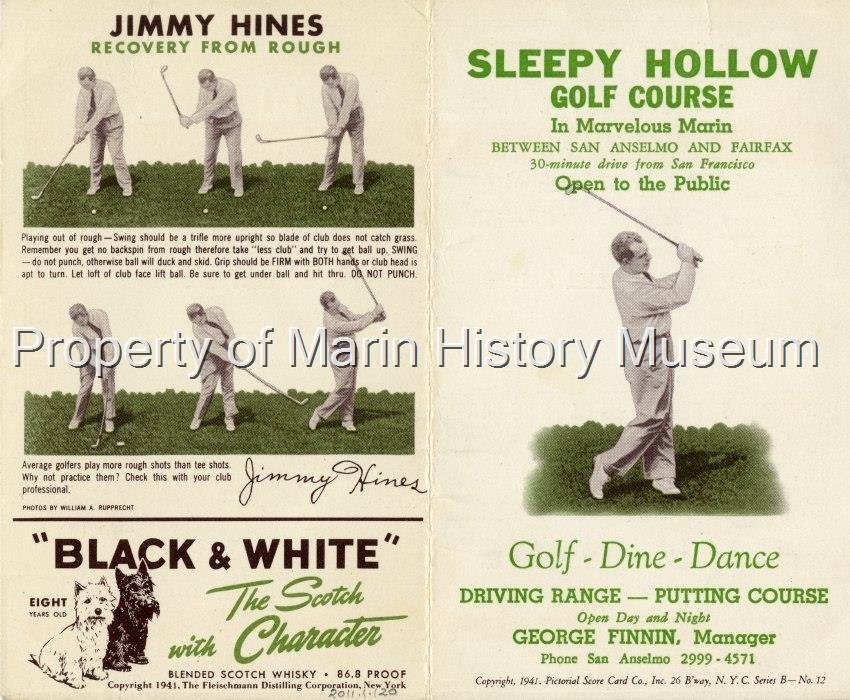
A scorecard printed in 1941 called the course open to the public, advertised "Golf – Dine – Dance" and a driving range and putting course open day and night, and named as manager, with the same telephone number Lake used for the dining room14,4.
The Week the Pros Came
The biggest week in the course's short life began on 1 May 1940, when the tournament committee of the Northern California Professional Golfers' Association walked all eighteen holes and pronounced it a fine course15. Their section championship had never been played in Marin County. Marvelous Marin, Inc. helped sponsor it, and was general chairman16. The winner would take $50017.
"Surrounded by rolling hills covered with many wild flowers and towering oak trees"
Qualifying was 36 holes on Sunday 26 May. of the California Golf Club took the medal with 138, one stroke ahead of of San Francisco19. Match play opened on Friday 31 May. Harry Bassler of Los Altos began eagle, birdie, birdie, eagle and still won by only one hole20. Taylor, the home pro, won his first match and lost in the afternoon to Tom LoPresti of Sacramento20,21.
In Saturday's semifinals the defending champion, of Sequoyah, beat LoPresti with a round of 6522, which the United Press said tied the course record set by two years before23. Bell won on the 20th after Vito Machado of Antioch drove into the creek on the 17th22.
The 36-hole final on Sunday 2 June was the best golf the valley ever saw. Fry led by one at lunch after a 6824,25. In the afternoon Bell went out in 35 and came home in 3125,24. On the 34th, the short 16th of 185 yards, he holed a fourteen-foot putt for a birdie two and the title, 3 and 225,24.
"Art Bell's putter was hotter than the day."
The papers called the 31 a new record for the back nine25,26. Their cards are also the best record of the course's shape: par 37 out and 34 in, 71 in all, with three short holes and two par fives, both on the way out24,22. This is not the par-36 first nine that opened in 1936; the papers do not say what changed.
A Club at Full Stretch
Two weeks later the club beat a team of twenty-one men from the Petaluma Golf and Country Club at home and lunched with them on the clubhouse porch32. In November the return match on Petaluma's hills went badly for the Marin men, 52½ to 19½33,34.
The clubhouse had a harder summer. In May 1940 an elderly San Francisco woman, Mrs. Alice Voris, fell in the dining room, broke her hip and sued Lake for $31,60035,36. The judge directed a verdict for Lake and then ordered a new trial37,38; how it ended has not been found.
In October 1940 the course was host to the Marin County Amateur championship39,40. led the qualifiers with a 7131, and the final paired George Sabin and 41, though its result is missing. A month later Palacio won the club championship, beating 8 and 742. In December the members elected Lewis president10, and in February 1941 the club joined the Northern California Golf Association43,44.
Then the club lost its professional. On 7 April 1941 Don Taylor left for the Mare Island club in Vallejo, and his assistant, Clair Dunham, took over45,46.
The spring of 1941 was the busiest the course ever had. The Marin Journal set a 36-hole tournament there for 17–18 May to mark its 80th year47,48. On 20 May sixty-two North Bay women came back49, and won Class A on her home course50. That evening the men's club held its annual dinner, a testimonial to the trophy donor W. M. Hughes51. In June the club lost narrowly to Santa Rosa, 21 matches to 1952, and a week later beat Petaluma 29 to 22; the Petaluma paper admitted that everything had gone right for its men except the golf53.
Smoke in the Valley
At 5:30 on the morning of 7 May 1941 the old Sleepy Hollow ranch house, a short way from the mansion, burned to the ground. J. A. Fagundes, his family and the ranch hands, ten people in all, got out with little more than the clothes they had on62. The district lay outside San Anselmo, and the Herald noted that the thirty-odd families now living in Sleepy Hollow had been asking for town fire protection62. The valley was filling with houses, and the cattle were still there too. Both facts would matter to the golf course.
That summer began to worry about the course's future in print. In his column of 17 July 1941 he reminded readers that he had urged the county to buy the Sleepy Hollow course, which could then have been had at a fair price, and called it better placed for most of the county's people than the old Marin Country Club63.
"With all its attractions, Marin really has few places to play; we need more."
Nothing came of it. In late September the grand jury began to ask why the water district charged the county's three golf courses half the usual rate64,65. Cheap water had kept the fairways green, and now even that was being questioned.
People were starting to leave. On 1 November 1941 opened a real estate firm in San Rafael66. That same evening Clair Dunham, now pro at Santa Rosa, was badly hurt in a car crash67; if he is the same man, as seems very likely, Sleepy Hollow had lost its second professional in seven months, and no successor is named. Even before the war the draft had taken Howard Capps, a former assistant pro there68.
Last Rounds
By the spring of 1942 the country was at war. The North Bay women cut their schedule to three meetings because of the tire shortage69. The same sports page noted that Jim George had won the Sleepy Hollow Golf Club tournament with a gross 80, but on the Sonoma golf course70,71. Neither paper says why. It was a bad sign when a club with its own eighteen holes held its tournament in another county.
The women kept playing at home, and on 23 June they held a guest day72. The course itself was in trouble. On 1 July 1942 George Finnan sued J. A. Fagundes for $3,024.50, saying the rancher's cattle had strayed onto the course again and again, and that twice, after he had them impounded, the defendants let them out in the night3,73. The outcome is not reported, but someone was still caring for the greens that summer.
On Tuesday 21 July 1942 the Women's Golf Team of Sleepy Hollow met for its weekly tournament, and Mrs. Charles Meyers and Mrs. Aurel Schneider won first and second low net74. It is the last report we have found of anyone playing golf at Sleepy Hollow.
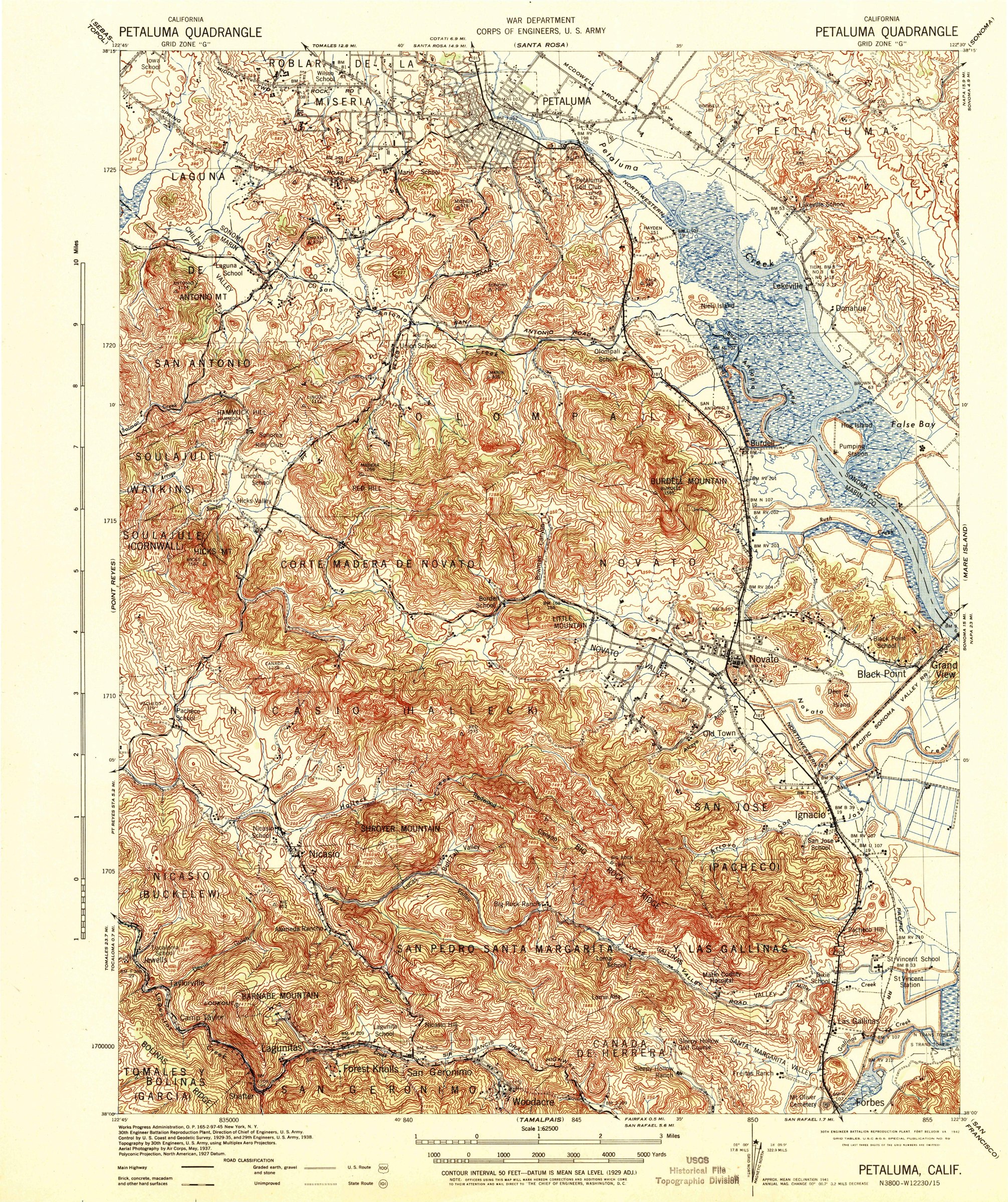
The map makers of 1942 put the course on their sheet just as it was ending. The clubhouse stayed open another year, and that August began advertising drinking, dining and dancing at Sleepy Hollow75,76. But no more golf was reported. By May 1943 the fairways where had played the back nine in 31 were under the plough77.
Notes to Chapter V (77 sources)
- “Page 3,” San Anselmo Herald, Jan. 4, 1940. view source ↗
- “Page 3,” San Anselmo Herald, Jan. 18, 1940. view source ↗
- “Page 2,” Petaluma Argus-Courier, July 3, 1942. view source ↗
- “Page 1,” San Anselmo Herald, Nov. 7, 1940. view source ↗
- “Page 1,” San Anselmo Herald, Sept. 26, 1940. view source ↗
- “University Women to Present Dinner,” Mill Valley Record, Nov. 15, 1940. view source ↗
- “Page 4,” San Anselmo Herald, May 22, 1941. view source ↗
- “Page 4,” San Anselmo Herald, Jan. 22, 1942. view source ↗
- “Page 1,” San Anselmo Herald, Feb. 1, 1940. view source ↗
- “Page 4,” Petaluma Argus-Courier, Dec. 12, 1940. view source ↗
- “Page 1,” San Anselmo Herald, April 4, 1940. view source ↗
- “Page 2,” Petaluma Argus-Courier, May 15, 1940. view source ↗
- “Page 10,” Santa Rosa Press Democrat, May 15, 1940. view source ↗
- Marin History Museum, Sleepy Hollow Golf Course scorecard, Object ID 2011.1.120. view source ↗
- “Page 4,” Petaluma Argus-Courier, May 2, 1940. view source ↗
- “Page 30,” Oakland Tribune, May 24, 1940. view source ↗
- “Page 2,” San Anselmo Herald, April 25, 1940. view source ↗
- “Pro Golf Match At Sleepy Hollow,” Mill Valley Record, May 24, 1940. view source ↗
- “Page 8,” San Anselmo Herald, May 30, 1940. view source ↗
- “Page 13,” Oakland Tribune, June 1, 1940. view source ↗
- “Page 6,” Santa Rosa Press Democrat, June 1, 1940. view source ↗
- “Page 12,” Oakland Tribune, June 2, 1940. view source ↗
- “Page 4,” Santa Rosa Press Democrat, June 2, 1940. view source ↗
- “Page 8,” San Anselmo Herald, June 6, 1940. view source ↗
- “Page 11,” Oakland Tribune, June 3, 1940. view source ↗
- “Art Bell Wins Pga Golf Title Here,” Mill Valley Record, June 7, 1940. view source ↗
- “Page 5,” San Anselmo Herald, Dec. 8, 1938. view source ↗
- “Pro-Amateur Golf Tourney Slated For Monday,” Mill Valley Record, Dec. 9, 1938. view source ↗
- “Page 32,” Oakland Tribune, Dec. 13, 1938. view source ↗
- “Page 8,” Sacramento Union, Dec. 13, 1938. view source ↗
- “Page 6,” Petaluma Argus-Courier, Oct. 9, 1940. view source ↗
- “Page 4,” Petaluma Argus-Courier, June 17, 1940. view source ↗
- “Page 3,” Petaluma Argus-Courier, Nov. 19, 1940. view source ↗
- “Page 4,” Petaluma Argus-Courier, June 25, 1941. view source ↗
- “Trips, Falls, Sues —Seeks $31,600,” Mill Valley Record, June 18, 1940. view source ↗
- “Damage Suit Fails To Bring $31,000,” Mill Valley Record, Nov. 22, 1940. view source ↗
- “Page 9,” Petaluma Argus-Courier, Nov. 18, 1940. view source ↗
- “Page 10,” Petaluma Argus-Courier, Dec. 18, 1940. view source ↗
- “Page 2,” San Anselmo Herald, Sept. 19, 1940. view source ↗
- “Page 3,” Petaluma Argus-Courier, Oct. 4, 1940. view source ↗
- “Sabin and Palacio In Golf Finals,” Mill Valley Record, Oct. 25, 1940. view source ↗
- “Page 1,” San Anselmo Herald, Nov. 28, 1940. view source ↗
- “Page 29,” Oakland Tribune, Feb. 7, 1941. view source ↗
- “Page 4,” Petaluma Argus-Courier, Feb. 7, 1941. view source ↗
- “Marin Golf Pro to Vallejo Links,” Mill Valley Record, April 8, 1941. view source ↗
- “Page 3,” Petaluma Argus-Courier, April 2, 1941. view source ↗
- “Page 14,” Salinas Index-Journal, March 11, 1941. view source ↗
- “Page 6,” Petaluma Argus-Courier, April 24, 1941. view source ↗
- “M.v. Woman Wins Golf Match,” Mill Valley Record, May 23, 1941. view source ↗
- “Page 8,” Santa Rosa Press Democrat, May 21, 1941. view source ↗
- “Page 2,” San Anselmo Herald, May 22, 1941. view source ↗
- “Page 4,” Santa Rosa Press Democrat, June 24, 1941. view source ↗
- “Page 7,” Petaluma Argus-Courier, June 30, 1941. view source ↗
- “Page 4,” San Anselmo Herald, Aug. 1, 1940. view source ↗
- “Page 6,” Santa Rosa Press Democrat, Aug. 17, 1940. view source ↗
- “Page 3,” Santa Rosa Press Democrat, Nov. 16, 1940. view source ↗
- “Page 10,” Santa Rosa Press Democrat, May 1, 1941. view source ↗
- “Page 4,” Santa Rosa Press Democrat, Aug. 14, 1941. view source ↗
- “Page 8,” Santa Rosa Press Democrat, Oct. 9, 1940. view source ↗
- “Page 10,” Santa Rosa Press Democrat, Oct. 10, 1941. view source ↗
- “Page 10,” Santa Rosa Press Democrat, Nov. 6, 1941. view source ↗
- “Page 6,” San Anselmo Herald, May 8, 1941. view source ↗
- “Page 1,” San Anselmo Herald, July 17, 1941. view source ↗
- “Water District Under Grand Jury Probe,” Mill Valley Record, Sept. 30, 1941. view source ↗
- “(>rand Jury Probes Marin Municipal Water District,” Sausalito News, Oct. 2, 1941. view source ↗
- “Page 1,” San Anselmo Herald, Oct. 30, 1941. view source ↗
- “Page 8,” Petaluma Argus-Courier, Nov. 3, 1941. view source ↗
- “Page 15,” Oakland Tribune, March 2, 1941. view source ↗
- “Page 10,” Santa Rosa Press Democrat, March 13, 1942. view source ↗
- “Page 6,” Santa Rosa Press Democrat, March 19, 1942. view source ↗
- “Page 9,” Petaluma Argus-Courier, March 19, 1942. view source ↗
- “Page 1,” San Anselmo Herald, June 25, 1942. view source ↗
- “Damage Suits Filed In Marin Court,” Mill Valley Record, July 7, 1942. view source ↗
- “Page 4,” San Anselmo Herald, July 23, 1942. view source ↗
- “Page 3,” San Anselmo Herald, Aug. 13, 1942. view source ↗
- “Page 1,” San Anselmo Herald, July 8, 1943. view source ↗
- “Page 8,” San Anselmo Herald, May 13, 1943. view source ↗
Potatoes, Homesites and Ashes
Dinner and Dancing, Without the Golf
After the women's Tuesday tournament of July 1942 the sports pages go quiet1. The clubhouse did not. Three weeks later was inviting Marin to drink, dine and dance with him at Sleepy Hollow2. The papers record no more golf; the old Hotaling mansion now earned its keep as a place to dine and dance. As late as April 1943 the Marin Business and Professional Women's Club held its installation dinner there3. By then the ground under the building had been sold.
The Week the Valley Was Sold
The golf company had never owned the valley. By the spring of 1943 the tract around the course belonged to the West Coast Life Insurance Company, and 's Sleepy Hollow Investment Company held an option to buy and resell it that ran out on 30 April4. What happened next is known in detail because it ended in court. In early April the company's attorney offered two dairymen, Sam and Zekie Smith, about 1,100 acres of ranch around the course for $39,000, keeping back the course itself, the spring water piped to the Club House and the ground by the clubhouse, which was to be sold for homes. The Smiths came back with changes and a check; the board rejected them and sold to other buyers. The Smiths sued and lost4,5.
The other buyers were , a paving contractor, and . On 15 April 1943 the Herald reported that 1,154 acres of the Hotaling property had sold for $67,5006. Raisch took the mansion and several hundred acres for $50,000 and planned to remodel the house and add a lake; Lang planned to cut his share into tracts7,6. The roughly 100 acres of golf course were to be divided into homesites, and the army had installed an ordnance unit at the old ranch buildings6,7,8.
answered on the same front page, under the title Save the Golf Course! He argued that the county or town should buy about thirty acres and keep nine holes, at a cost to the average homeowner of about $1.50 in taxes. Most of the men who had played Sleepy Hollow, he reminded readers, were away fighting. Who would lead off?6
Spuds, Soldiers and Lots
Nobody did. Four weeks later Weaver reported the result.
"So They Plowed up the Old Golf Course."
The greens had cost a thousand dollars apiece; potatoes and corn were to replace them. Not one citizen had come to his office about the nine holes. Perhaps, he joked, the spuds would help America make a hole in one across the pond9. By mid-May 1943 the course was gone.
The army stayed on. In June fifty soldiers from the camps at Sleepy Hollow and the old golf course helped fight a grass fire10, and that autumn the Sleepy Hollow Ord softball team beat Nicasio three games to two11,12. left on 10 July 1943, after four years at Sleepy Hollow, to open Rancho Nicasio13,14.
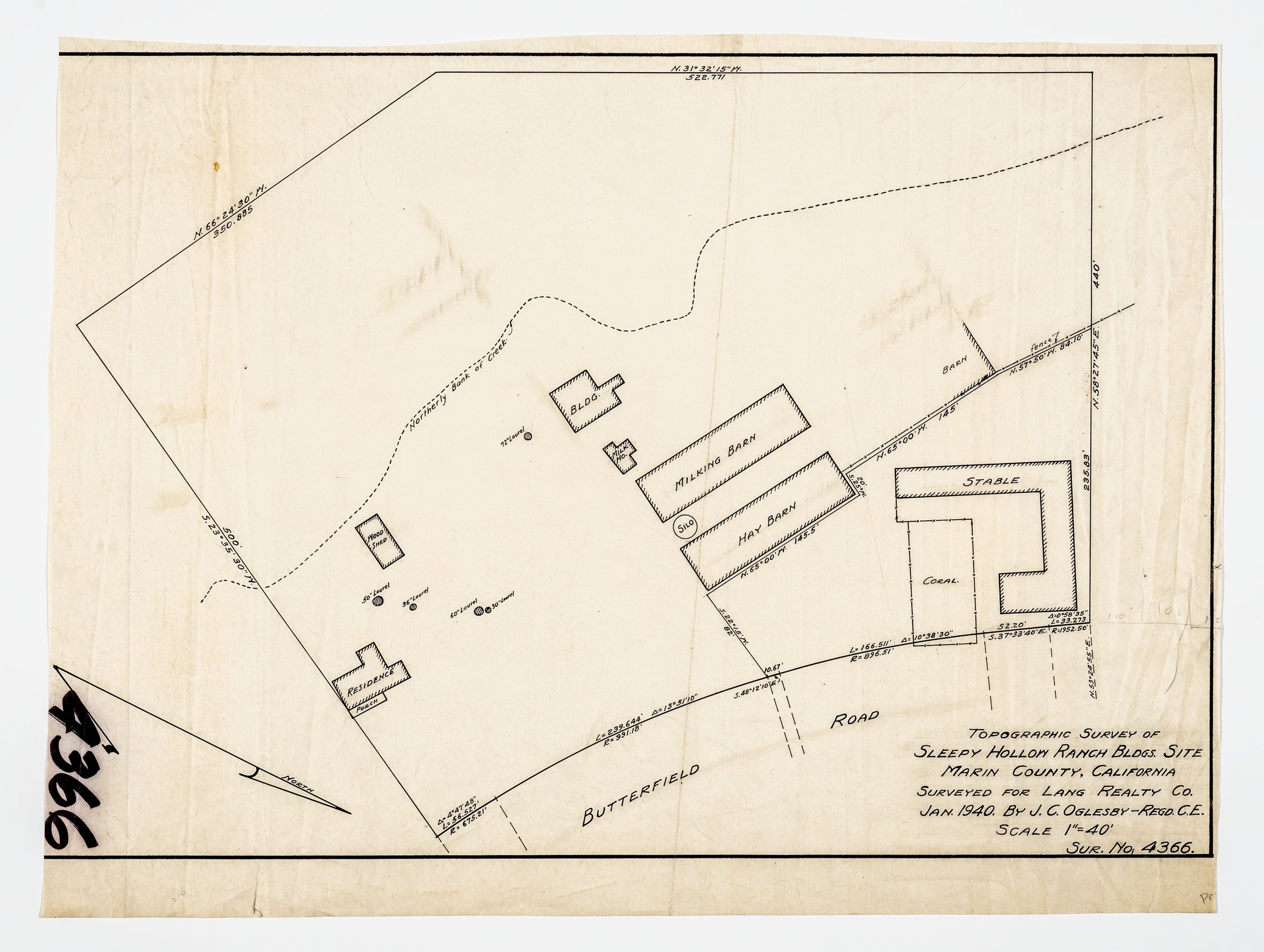
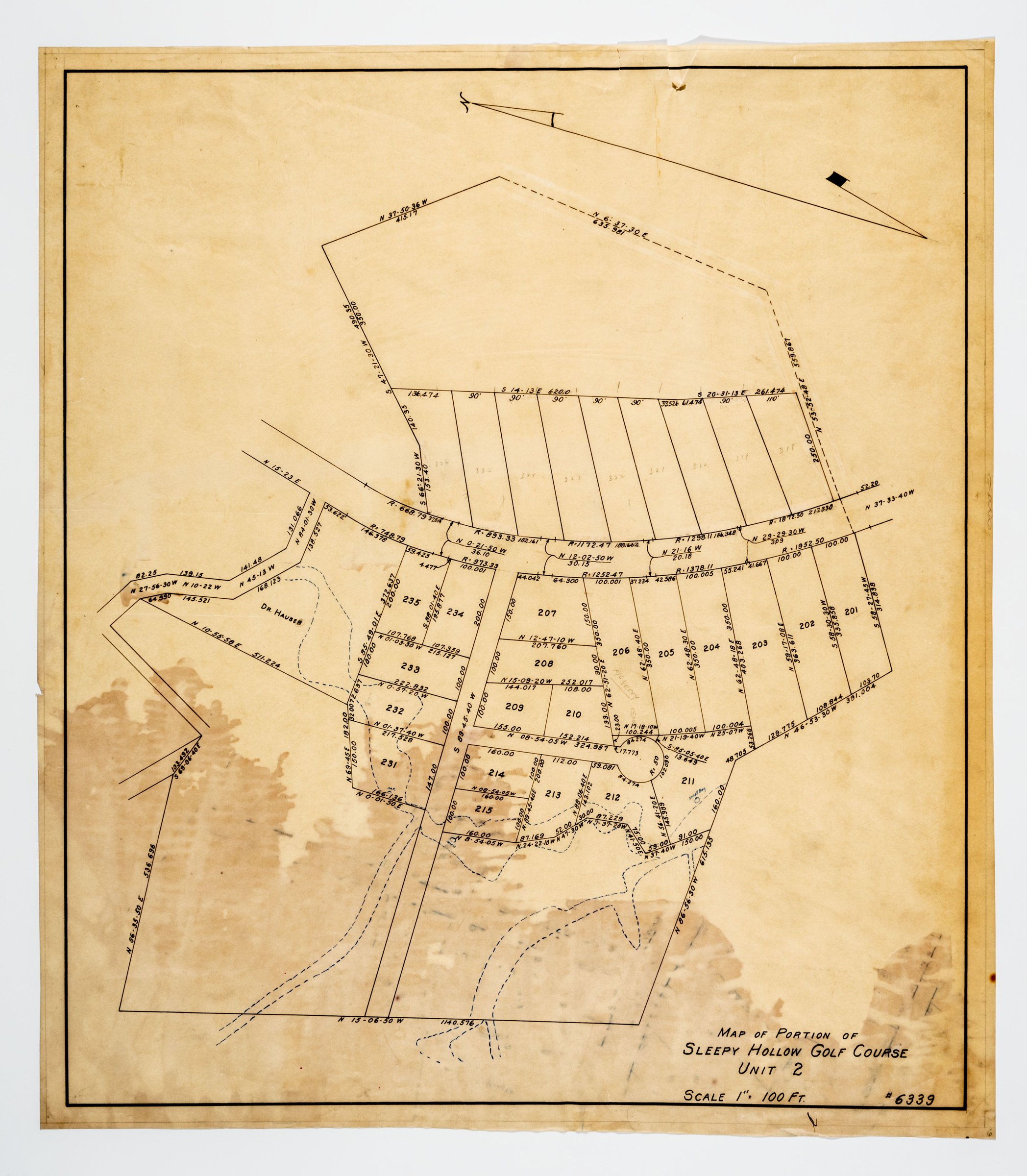
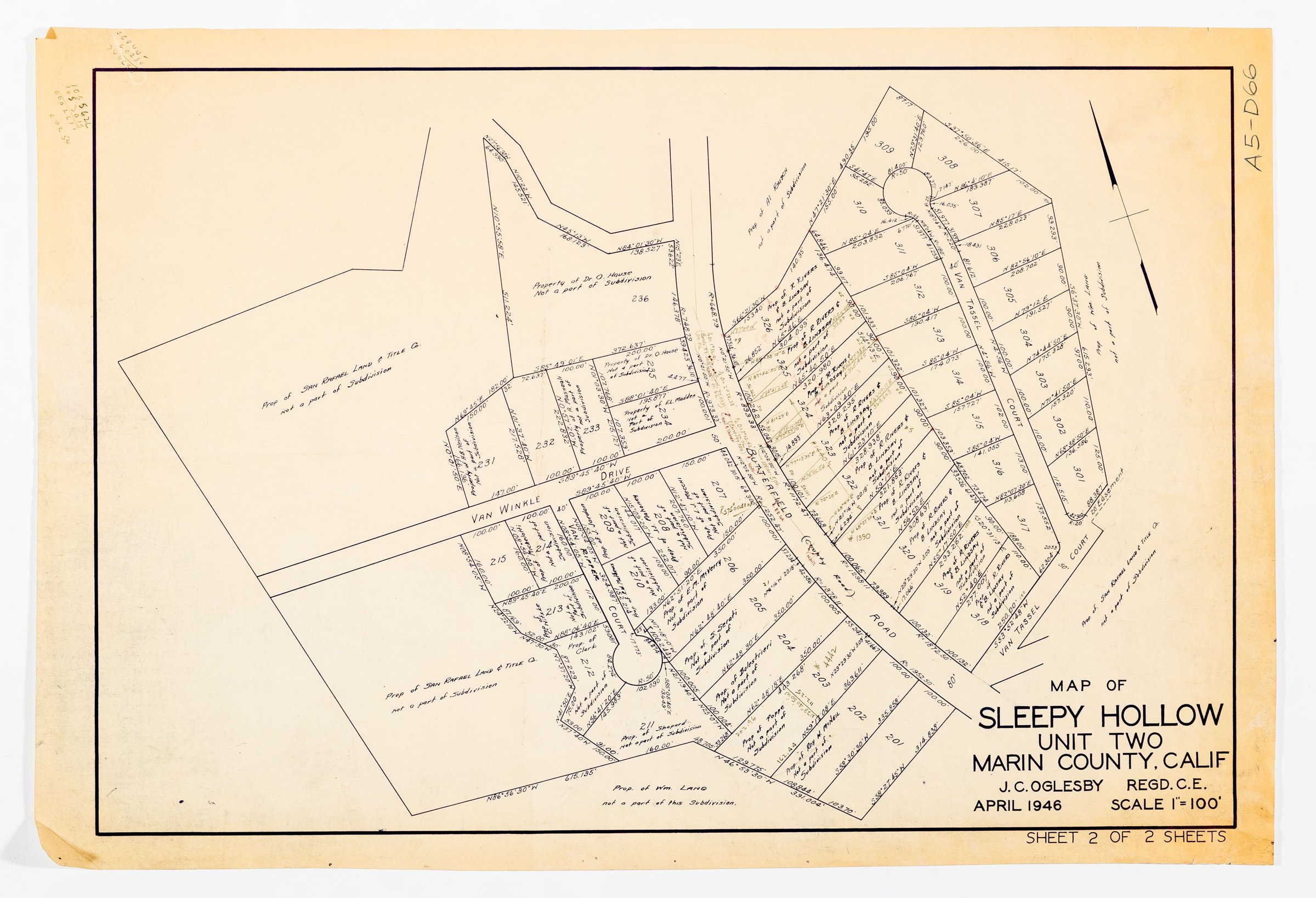
The surveyors moved in next. By 1944 J. C. Oglesby had mapped a portion of the old links as numbered house lots, still headed Sleepy Hollow Golf Course, Unit 215. In 1945 owners at the lower end of the valley petitioned to join San Anselmo; the Herald described their area as centred on the "former greens 4, 5 and 6 of the Sleepy Hollow golf course."16 At the end of May 1945 the reorganized investment company sold 87 acres of the former course for $91,000 to Kaenel, and the builder , who sold thirty homesites in a week, five of them to doctors. Lots had to have at least 100 feet of frontage, so that nobody would build right up against a neighbour17.
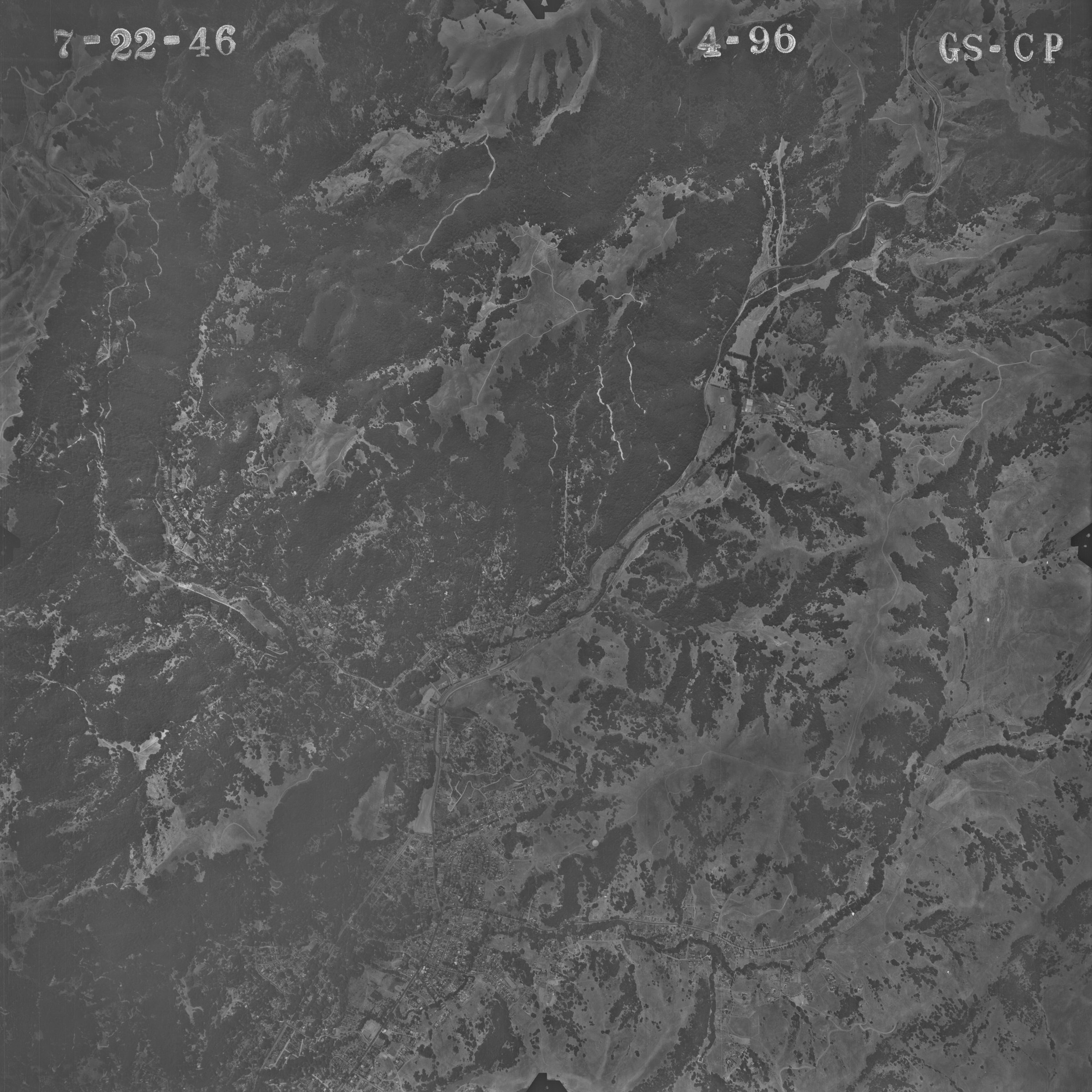
The new streets took their names from Washington Irving: Oglesby's April 1946 map shows Van Tassel, Van Winkle and Van Ripper running off Butterfield Road18. A USGS survey plane photographed the valley on 22 July 194619. As late as 1956 the county's tax lists still described a road strip beginning at the southeast end of the course20.
The Big House on the Hill
At the head of the valley, Raisch and his wife, Katherine, moved into the Hotaling mansion and gave it modern plumbing, a swimming pool, an artificial lake and a dancing pavilion21. It was a party house again. In 1945 about 480 guests came to the Raisch paving company barbecue in the grove22, and in May 1948 some 3,000 Shriners drove out for an outdoor ceremonial23. In August 1949 Raisch, in colourful costume, was ringmaster at a junior horse show at the Sleepy Hollow Stables that drew more than 2,500 spectators24.
A 1952 Independent-Journal article by Helen Selinger was the first full retrospective of the valley, and some of what later writers repeat starts there, including a Chicago syndicate where the contemporary papers spoke of eastern capital26,7.
Early on Sunday, 17 February 1957, the mansion burned28. The house was empty, the fire chief thought youngsters had set it, and the developers who owned it had planned to tear it down that spring and subdivide the ranch29,30.
The Sisters and the Steps
For a few years the hilltop lay open; in 1964 a guide to family outings suggested walking up past the burned-down mansion to a drained lake-bed31.
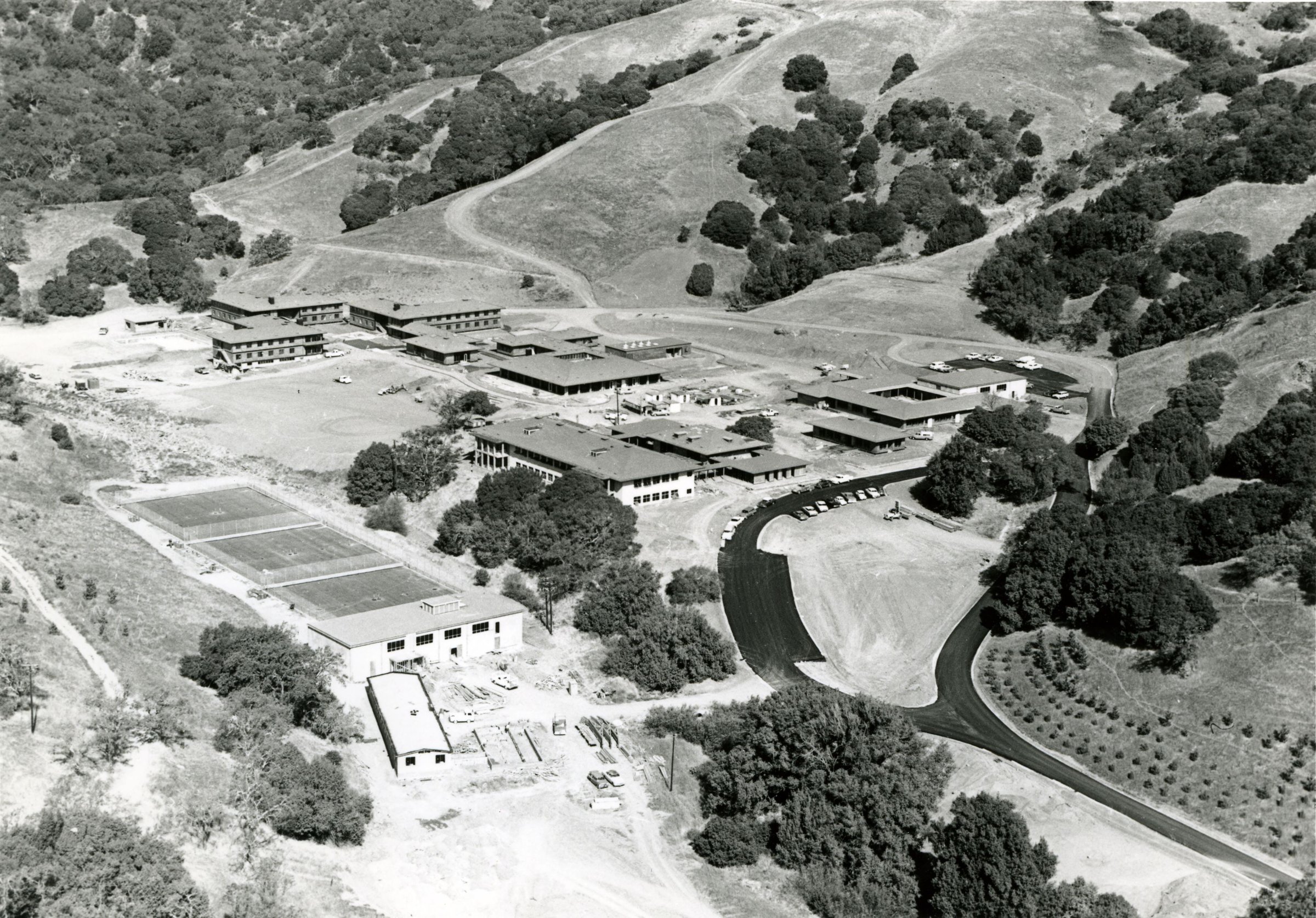
The Dominican Sisters built their new school there. On a rainy Saturday in December 1965 the convent school moved from San Rafael with a Century Plus Parade, led by a six-horse carriage, and became San Domenico School for Girls32,33. Its formal dedication came on 30 April 196634.
Very little of the golf course survives. At San Domenico's entrance the stone steps that once climbed to Hotaling's veranda still stand with fragments of the foundation. They appear in photographs of the clubhouse in the 1930s, and today they lead nowhere27. Below them the streets carry the Irving names, and Fawn Drive runs through the area once centred on the old fourth, fifth and sixth greens16,35.
The story most often told today is that the course closed in 1939 for lack of water34. Water was a real worry; in 1937 the course was behind on its water bills36. But it survived to hold the Northern California PGA championship in 1940, its women played into July 1942, and Weaver was still trying to save nine holes in April 194337. It ended because of war and real estate: the players went into uniform, the land was sold, and the fairways went under the plow1,6,9.
The golf writers remembered it that way. In 1949 a Marin pro looking for land for a new public course noted that the county once had courses at San Rafael and at Sleepy Hollow, and that both had been subdivided for homes38. In 1957 a Healdsburg columnist listed the Sleepy Hollow Golf Club among the Redwood Empire's lost courses, "victims of the depression of the thirties and later construction expansion."39 The verdict was fair. Sleepy Hollow was a Depression course, built in a valley that had already beaten several grander schemes. It lasted only six seasons as an 18-hole links, from April 1937 to the summer of 1942, before the houses arrived, and those houses are what make up the neighbourhood today.
Notes to Chapter VI (39 sources)
- “Page 4,” San Anselmo Herald, July 23, 1942. view source ↗
- “Page 3,” San Anselmo Herald, Aug. 13, 1942. view source ↗
- “Page 8,” San Anselmo Herald, April 29, 1943. view source ↗
- Cal. Court of Appeal (65 Cal.App.2d 75), 1944-06-26, p. 75-80 view source ↗
- “Page 8,” Petaluma Argus-Courier, June 3, 1943. view source ↗
- “Page 1,” San Anselmo Herald, April 15, 1943. view source ↗
- “Page 10,” Petaluma Argus-Courier, April 15, 1943. view source ↗
- “Page 5,” Santa Rosa Press Democrat, April 15, 1943. view source ↗
- “Page 8,” San Anselmo Herald, May 13, 1943. view source ↗
- “Page 8,” San Anselmo Herald, June 24, 1943. view source ↗
- “Page 4,” Petaluma Argus-Courier, Aug. 11, 1943. view source ↗
- “Page 4,” Petaluma Argus-Courier, Oct. 6, 1943. view source ↗
- “Page 1,” San Anselmo Herald, July 8, 1943. view source ↗
- “Page 4,” San Anselmo Herald, July 8, 1943. view source ↗
- Marin County Free Library, Anne T. Kent California Room, Map of ptn of Sleepy Hollow Golf Course unit 2, 6339. view source ↗
- “Page 1,” San Anselmo Herald, May 11, 1945. view source ↗
- “Page 1,” San Anselmo Herald, June 7, 1945. view source ↗
- Marin County Free Library, Anne T. Kent California Room, Map of Sleepy Hollow unit 2 [Butterfield, Van Tassel, Van Winkle, Van Ripper], A-5-D66. view source ↗
- UCSB Library Geospatial Collection, Aerial photograph, flight GS-CP frame 4-96, GS-CP 4-96. view source ↗
- “Page 6-A Advertisements Column 1,” Mill Valley Record, May 31, 1956. view source ↗
- San Anselmo Historical Museum, Katherine and Albert Raisch, Catalog No. 2069. view source ↗
- “Page 6,” San Anselmo Herald, Sept. 6, 1945. view source ↗
- “Page 8,” Santa Rosa Press Democrat, May 9, 1948. view source ↗
- “Page 5,” Petaluma Argus-Courier, Aug. 11, 1949. view source ↗
- “Page 26,” Santa Rosa Press Democrat, Dec. 20, 1953. view source ↗
- San Rafael Independent-Journal, 1952-09-20, Marin Magazine, p. M15-M16 view source ↗
- https://sananselmohistory.org/articles/then-now/hotaling-mansion/ view source ↗
- “Page 1,” Petaluma Argus-Courier, Feb. 18, 1957. view source ↗
- “Page 10,” Santa Cruz Sentinel, Feb. 18, 1957. view source ↗
- “Page 2,” Press-Tribune (Roseville), Feb. 18, 1957. view source ↗
- “Many Family Outing Areas Here,” Mill Valley Record, June 10, 1964. view source ↗
- “Colukhil Bui Kain SWtKI Move For Dominican Convent,” Sausalito News, Dec. 15, 1965. view source ↗
- Marin County Free Library, Anne T. Kent California Room, Aerial view of the final construction of San Domenico School for Girls campus, Sleepy Hollow, October 1965 [photograph], csrcl_338. view source ↗
- Audre LaBelle, “History,” Sleepy Hollow Homes Association. view source ↗
- “Page 5,” San Anselmo Herald, Feb. 1, 1945. view source ↗
- “Page 4,” Petaluma Argus-Courier, July 17, 1937. view source ↗
- “Page 4,” Santa Rosa Press Democrat, June 2, 1940. view source ↗
- “tons Are Revealed for 18-Hole Golf Course in Marin County Golf Pro Says "Chances Good" To Have Course Before 1950; Would be North of San Rafael,” Mill Valley Record, Sept. 2, 1949. view source ↗
- “Across The Sports Desk,” Healdsburg Tribune, Enterprise and Scimitar, Sept. 26, 1957. view source ↗